Pages

Showing posts with label film commentary. Show all posts

Monday, March 31, 2025

The Rule of Jenny Pen: A Geri-Horror Masterclass

There is a growing trend within the horror genre in which aging is being employed as a mechanism of terror. Geriatric horror—or, abridged, geri-horror—is taking the inevitably of aging (frightening in its own right) and factors closely associated with growing older (dementia and cognitive decline, physical deterioration, isolation and loneliness, communities for the elderly such as nursing homes and assisted living facilities) and examining them through the context of the horror genre.

Geri-horror is the natural successor to the hagsploitation movement in film of the 1960s and 1970s in which former Hollywood starlets would play deranged old women. The formula was simple: glam it down and camp it up. This subgenre—also known as “hag horror” or “grand dame Guignol"—captured Hollywood's seeming disdain for older women at the time yet, in an ironic, subversive twist, gave some of these actresses the best roles of their later careers. Think Joan Crawford and Bette Davis in Whatever Happened to Baby Jane? (1962) or Davis (again), Olivia De Haviland, and Agnes Moorehead in Hush…Hush, Sweet Charlotte (1964) or Crawford (again) in Straight-Jacket (1964) or Geraldine Page and Ruth Gordon in What Ever Happened to Aunt Alice? (1969) or Shelley Winters in both Whoever Slew Auntie Roo? (1971) and What's the Matter with Helen? (1971).

In geri-horror, expectations that elderly people are kind and harmless are upended. Take Minnie and Roman Castevet in Rosemary’s Baby (1968), for example, who turn out not to be frail elderly neighbors but satanic cultists and master manipulators in the plot to bring the Antichrist into being. Keeping with the satanism theme, there’s the entire community of senior citizens in the film The Brotherhood of Satan (1971) who are turning the children of a small California desert town into Satan worshipers or the eccentric Ulmans, played by Tom Noonan and Mary Woronov, in Ti West’s The House of the Devil (2009) who lure a young babysitter into a sinister trap. In 1988, The Legend of Hell House director John Hough employs silver screen legends Yvonne DeCarlo and Rod Steiger to play the unhinged parents of a weird, murderous family in the slasher American Gothic. Earlier, Lassie actor Arthur Space and television actress Mary Jackson played deranged proprietors of a sham resort where vacationing college girls were lured, fattened up, and then (literally) served up on platters in the lurid Texas Chainsaw Massacre cannibalism precursor, Terror at Red Wolf Inn (1972).

At other times in geri-horror, old age itself is the source of the horror. In the film adaptation of Peter Straub’s novel Ghost Story (1981), a group of elderly men calling themselves the Chowder Society are plagued by guilt-ridden nightmares stemming from an impulsive act in their collective past. In the film Late Phases (2014), werewolves preying upon the residents of a retirement community become a metaphor for struggling to relocate a physically challenged parent against their will into a retirement community. This one is stacked with a fantastic over-60 cast that includes Tina Louise (Gilligan’s Island), Rutanya Alda (Mommie Dearest, Girls Nite Out, Amityville II: The Possession, The Dark Half), Caitlin O’Heaney (Savage Weekend, He Knows You’re Alone), Karen Lynn Gorney (Saturday Night Fever), and Tom Noonan (Wolfen, The Monster Squad). In M. Night Shyamalan’s pandemic-era Old (2021), the acclaimed director adapts the French-language graphic novel Sandcastle written by Pierre Oscar Lévy from France and drawn by Frederik Peeters from Switzerland, taking the body horror route to show aging as grotesque and inescapable—much in the way 2024’s The Substance does. Shyamalan’s other geri-horror contribution—2015’s The Visit—offered up a pair of sinister grandparents whose increasingly bizarre and disquieting behavior is cleverly couched within the Alzheimer’s symptom of “sundown syndrome.” Dementia takes centerstage in Relic (2020), an Australian gem of a cinematic metaphor about how the disease not only wreaks havoc on the victim but also on those closest—often caregivers.

In yet other works, aging is a badge of honor—and a weapon in confronting horror. In She Will (2021), Alice Krige plays an aging actress who goes to a healing retreat after a double mastectomy, where she discovers that the process of such surgery opens up questions about her very existence, leading her to start to question and confront past traumas. Likewise, Jamie Lee Curtis stepped back into her iconic role as terrorized babysitter Laurie Strode for David Gordon Green’s trilogy Halloween (2018), Halloween Kills (2021), and Halloween Ends (2023)—only this time her PTSD has fueled her preparedness, making her an AARP card-carrying survivalist and Final Grandma. This theme of “Don’t Fuck with Old People” is carried out again in Don’t Breathe (2016) and VFW (2019).

Requisite history lesson aside, The Rule of Jenny Pen (2025)—directed by James Ashcroft and written by Ashcroft and Eli Kent, based on the short story of the same name by Owen Marshall—is the latest, and perhaps most fully realized contribution to the geri-horror subgenre to date. This haunting, malicious New Zealand-lensed psychological tale of elder-on-elder abuse features Academy Award winner Geoffrey Rush as Stefan Mortensen, a judge who suffers a stroke, mid-sentencing, from the bench. He finds himself admitted to a nursing home (or “care home” as is the geographic idiom) for rehabilitation. His character, seemingly friendless, is the epitome of an entitled elite—dismissive toward women, caustic, and outright rude at times. The post-stroke wheelchair he finds himself in does little to humble him. Enter multiple Emmy and Tony Award winner and two-time Academy Award nominee John Lithgow as Dave Crealy, a fellow resident who’s as kooky as he is dangerous. Before becoming a resident, Crealy was the longtime handyman at Royale Pine Mews and that familiarity with the facility and its grounds gives him a different type of entitlement. He’s a geriatric bully—commandeering other residents’ food when the well-meaning if inattentive staff isn’t looking, aggressively shoving other residents out of the way during a dance activity, and—worst of all—paying nocturnal visits to his fellow residents’ room in the middle of the night to terrorize them with an eyeless hand puppet he calls Jenny Pen. The scenes in which Lithgow demands a pledge of allegiance to the titular doll that includes “licking its asshole” (thankfully, just the underside of Lithgow’s wrist) are chilling to the bone. Ashcroft wisely uses Lithgow’s towering 6’4” frame to powerfully frame the power dynamic between him and his frail elderly counterparts.

Crealy’s cruelty to the nursing home’s other residents varies from the humiliating (dumping a urinal full of pee onto Mortensen’s crotch while in bed) to the downright sadistic (tugging violently on the newly-inserted catheter of Mortensen’s roommate Tony Garfield (George Henare) or leading a demented woman who spends the majority of her screen time looking for the family about to pick her up and take her home any minute out of the gated grounds where tragedy befalls her). Although Mortensen reports the abuse, the nursing home’s administration does little to investigate, dismissing his concerns as part of his adjustment disorder. As Mortensen’s rehab fails to progress, he gradually loses his voice to the endemic ageism that sees the institutionalized elderly as ignorable. Still, Mortensen is determined to bring Crealy’s reign of terror to an end—using whatever means necessary. The film gradually builds in a tense game of cat-and-mouse before the two geriatric foes finally square off.

Ashcroft and company do a superb job of portraying life in a nursing home—from the near-drowning Mortensen experiences when left unattended in a bathtub when the aide leaves to retrieve towels to the way the center’s staff is portrayed as generally caring more about completing tasks than listening to what their elderly charges try to tell them. There is an intrinsic sadness hanging over Royale Pine Mews even as festive activities take place in the background and the residents’ care needs seem tended to adequately enough. It’s here—in the loneliness and social isolation at the end of one’s life, when autonomy is slowly lost and hope abandoned—that the geri-horror aspects of The Rule of Jenny Pen really kick in. There can be no happy ending because even if the villain is defeated, the audience knows that there is no escape for Mortensen from the decay aging brings.

Circling back to our de facto history lesson at the beginning of this review, The Rule of Jenny Pen is also notable for subverting the rules of the hagsploitation subgenre—here enlisting two Hollywood males of a certain age (Rush, 73 and Lithgow, 79) and placing them in the psycho-biddy cinematic scenario usually reserved for women. Ashcroft ably proves that the horrors of growing old in an ageist society aren't reserved just for women. It’s just another bit of the understated brilliance of this film that will likely go on to have a long shelf life.

Sunday, June 7, 2020

Review: ‘Scream, Queen! My Nightmare on Elm Street’


I finally had the opportunity to catch Scream, Queen! My Nightmare on Elm Street, the documentary that explores the infamous homoerotism of the first sequel to Wes Craven’s 1984 classic A Nightmare on Elm Street. Co-directed by Roman Chimienti and Tyler Jensen, this heartfelt documentary examines this aspect of the oft-maligned ’85 sequel in a unique way—by focusing on the human toll the film’s reputation took on its leading man.

Mark Patton was just 25 when he was cast as the lead in A Nightmare on Elm Street 2: Freddy’s Revenge, quite the professional coup after leaving home in the Midwest at 17 to pursue his dreams of a career as an actor. Patton’s all-American good looks led to immediate bookings in national commercials, with his big break coming shortly thereafter when he landed a plum supporting role in the Broadway play Come Back to the Five and Dime, Jimmy Dean, Jimmy Dean, directed by Robert Altman and starring Cher, Sandy Dennis, Karen Black, and a pre-Misery Kathy Bates—a role he repeated in the subsequent film version. By the time he landed the role of Jesse Walsh in the Elm Street sequel, Patton—who was gay and closeted, as the times dictated—had moved out to Hollywood where he met and began a relationship with Dallas actor Timothy Patrick Murphy.

Despite its commercial success, Freddy’s Revenge was widely derided and eventually became known in the early days of Internet film analysis as "the gayest horror movie ever made." Although time—and evolving social mores—have been kind to the film and elevated it to the status of a cult classic and even revered because of its not-so-subtle-after-all gay subtext, Patton’s career became collateral damage. The actor was wrecked by the negative response to the film and comments about his performance. Following an episode of Hotel and a CBS Schoolbreak Special, in which he co-starred—ironically—with A Nightmare on Elm Street final girl Heather Langenkamp, his acting career came to an unceremonious end. His personal life was no better—Murphy would die, tragically, of AIDS in 1988 at the age of 29 and Patton’s own HIV-positive diagnosis would eventually follow, complicated when he came down with tuberculosis. He left Hollywood in due course upon his recovery, retreating down to Puerto Vallarta, Mexico, where he entered into decades of self-imposed exile—albeit with some newfound personal happiness in the form of a husband and an art store, where he sells works of his own creation, including a line of painted handbags he designed.

In 2010, Daniel Farrands, director of the exhaustive Elm Street documentary Never Sleep Again, tracked Patton down and entreated him to speak openly about his experiences and his legacy as part of the iconic film franchise. It was during his participation in Never Sleep Again that Patton came to realize just how dramatically the critical and cultural tide had begun to turn in favor of Freddy’s Revenge, with the film now hailed for the very thing that had caused him so much past anguish. Patton found himself applauded across the horror convention circuit, and that led to his desire to get his life story out into the world by developing a film (then) called There Is No Jesse. Unbeknownst to him, he would soon cross paths on social media with two aspiring filmmakers with a shared love for A Nightmare on Elm Street 2—and four years later, the trio gifts fans with Scream, Queen! My Nightmare on Elm Street.

Chimienti and Jensen have crafted a polished and engaging documentary, utilizing interviews, archival footage, and a “day-in-the-life-of” approach as they follow Patton from one convention to another. Although the documentary threatens at times to burst at its seams with all that the filmmakers earnestly include here, it’s Patton—the film’s center—who grounds the proceedings with his candid, sometimes achingly bittersweet recollections of his journey. Watching Scream, Queen! My Nightmare on Elm Street, I found myself raging at times over the homophobic inner-workings of the Hollywood machine during the AIDS plague, cheering for Patton’s self-discovery and journey to reclaim his legacy at others. It’s hard not to find yourself in a puddle of tears watching how Patton is revered by the Elm Street fans and to feel the palpable sense of empowerment as he takes to the stage to rightfully affirm his place as horror’s original “final boy” while embracing the “scream queen” title that was once weaponized against him. 

The central conflict of the documentary is framed between Freddy’s Revenge screenwriter David Chaskin and Patton, with the latter holding firm to the claim that Chaskin disingenuously skirted responsibility for the film’s overtly gay subtext. Chaskin long-maintained that it was Patton’s performance that was responsible for the film’s gay overtones that unsettled audiences upon its release, even going on record with the proud admission that his screenplay was meant to be homophobic versus homoerotic. In this 2007 interview with Bloody Good Horror, Chaskin says:

“Yes, there was certainly some intentional subtext but it was intended to play homophobic rather than homoerotic. I thought about the demographics for these types of films (young, heterosexual males) and tried to imagine what kinds of things would truly frighten them, to the core. And scary dreams that make them, even momentarily, question their own sexuality seemed like a slam dunk to me.

If you really wanted to have fun, one might argue that the entire movie is a metaphor—Jesse is, in the end, finally able to control the monster inside him (his latent homosexuality) with the love of a good woman. Maybe they should show this film at one of those evangelical deprogramming sessions where they try to ‘fix’ gay people into regular Americans.

That said, there were certain choices that were made (e.g., casting) that, I think, pushed the subtext to a higher level and stripped away whatever subtlety there may have been. To this day, Jack Sholder says he read no such subtext into the script. It must have been by osmosis. At any rate, he should have seen it coming—when we opened in New York, we got a rave review in The Advocate.”

It’s here—with the resolution of this central conflict—that my one and only criticism with this otherwise pitch-perfect documentary comes into play: Chimienti and Jensen should have skipped it. It falls flat and lacks the requisite catharsis necessary to resolve the focal tension the film devotes much of its 99-minute running time to exploring. What should play as a pivotal moment in Patton’s liberation from this emotional shackle that he’s carried with him for more than three decades comes across as anticlimactic, with Chaskin’s “apology” being anything but. It’s a jarring moment of insincerity in what’s been nothing but a pervasive sense of sincerity throughout the rest of the film. Even Patton looks nonplussed. It’s an awkward scene that fails to give the audience the payoff it’s expecting—and the moment of unequivocal apology that Patton deserved.   

Yes, Chaskin is an asshole for intentionally injecting homophobia into his script, but I found Freddy’s Revenge director Jack Sholder far more culpable for his part in dodging accountability—and almost insultingly so. The film—as in, the one Sholder directed—includes a sequence in a gay bar (that was shot in an actual gay bar!), frequent male nudity, crotch shots, and glistening male chests, a bare-assed towel-whipping of a naked restrained man in the shower, a scene in which Freddy Krueger caresses Jesse's face before suggestively sticking a clawed finger in his mouth (which actor Robert Englund even admits was meant to be homoerotic), Patton in tighy-whities, Patton in a jockstrap, and Patton's butt-bumping solo dance to “Touch Me (All Night Long)” by Wish featuring Fonda Rae. That Sholder can claim no knowledge, no awareness of the gay subtext in his own movie is maddening to watch—especially in a later scene in which he basically tells Patton that it’s time to “get over it.” I was left shouting “WTF?!” at my television and wanting to throw the remote at Sholder’s clearly dishonest attempt to remove himself from any semblance of answerability by claiming naiveté. 

Chimienti and Jensen wisely employ a diversity of voices to fill their documentary’s requisite talking head roles, from the film’s cast and crew, to fans, to film scholars. UC Colorado Film Studies professor Andrew Scahill provides some of the film’s best academic moments, providing salient points in support of reclaiming A Nightmare on Elm Street 2 as a progressive film about sexual identity. Drag performer Peaches Christ also speaks persuasively about the connection between horror and the queer experience. The reunion scenes between Patton and his NOES2 cast members have a trepidatious energy running throughout—no one (besides maybe character actor Marshall Bell) seems completely at ease. Still, it’s great to see Kim Myers, Clu Gulager, Robert Rusler, JoAnn Willette, Englund, and Bell all together again.

The filmmakers take on a lot—from online bullying and the devastating effects of the AIDS crisis on the gay community to final girl film theory and queer cinema. Despite its ambitions that—in less capable hands—could have derailed the train, Chimienti and Jensen somehow manage to keep this hefty cinematic locomotive on the tracks, ultimately crafting an intensely personal, often painful, and surprisingly moving exploration of the life of a young gay man who reached for his Hollywood star during the Reagan era only to watch it fall from the sky as quickly as it began to rise against the backdrop of AIDS and the homophobia of the period. While Scream, Queen! My Nightmare on Elm Street may have started out as a passion project for two gay horror fanboys and a lost celebrity they connected with online, it establishes itself as an instantly significant contribution to the oeuvre of film and the canon of LGBTQ studies. That Chimienti and Jensen are able to, in effect, teach an important lesson in queer history to a predominantly heterosexual audience by following Patton’s journey from closeted Missourian teenager and aspiring actor to self-described “Greta Garbo of horror” to his creative rebirth is nothing short of remarkable—especially for two first-time documentarians. As Patton says near the end of the film:

“My generation is gone. I have no friends my age. I want people to know their history. I want them to at least hear from somebody that the way the world is now…it wasn’t this way five minutes ago.”

Scream, Queen! My Nightmare on Elm Street is a heartrending requiem to missed potential and man’s ability to rewrite his narrative—tracing a proud scream queen’s journey from promise and unlimited potential through the darkness of crippling pathos and out into the light of hard-won personal peace. It’s about the promise of a second act no matter how long the first one runs over. 

Tuesday, January 14, 2020

‘Underwater’ Keeps Its Head Above the Déjà Vu


Movie audiences have been long conditioned toward preconception and expectation based on a film’s release date. It’s become generally accepted that films released just before Memorial Day and July 4th are expected to be the big-budget summer blockbusters—those box office juggernauts whose special effects budgets are eclipsed only by their marketing costs. The more serious, arty films are released between Thanksgiving and Christmas, with the expectation of garnering awards nominations. Then there is January—that post-holiday cinematic graveyard when studios unceremoniously dump films for which they have little to no expectations into theaters where they sink or swim. Deep-sea actioner Underwater neither sinks nor swims—it dogpaddles.

As far back as The Creature from the Black Lagoon (1954), there’s been a fascination with what lurks beneath the depths. Like deep space, the deep sea holds an element of the unknown and limitless possibility for all manner of imagined terrors, and filmmakers have been mining these creative waters since the early years of the Cold War era. I can trace my love of these underwater-set creature features all the way back to my childhood and one film, in particular—1966’s Destination Inner Space, in which a group of scientists aboard an undersea laboratory do battle with an extraterrestrial amphibian monster.

There have been no shortage of terror-under-the-seas flicks since—from 1973’s The Neptune Factor to 1998’s Sphere and 2005’s The Cave. 1989 seemed to be a particularly robust year for underwater monster mayhem with Leviathan, The Abyss, Deepstar Six, Lords of the Deep, and The Rift (aka Endless Descent) all released to varying degrees of success. Sometimes, the underwater terror made its way to the surface in films like Humanoids from the Deep (1980), Deep Rising (1998), and The Rig (2010). Other times, amplifications of familiar sea creatures—sharks, killer whales, piranha, octopus, even crabs—skimmed the surface to wreak havoc on fictional seaside communities.  

Underwater is the latest entry in this dubious tradition of sub-genre, a stylized big-budget film whose price tag (estimated at $80 million) can’t hide its B-movie pedigree. Sharing more plot-wise with Deepstar Six and Leviathan, Underwater takes place seven miles beneath the ocean’s surface on the bottom of the Mariana Trench at an underwater mining operation owned by one of those nefarious-sounding, faceless corporate entities called Kepler. The audience is barely introduced to aquatic engineer Norah (Kristen Stewart) before all hell (literally) breaks loose and much of the undersea complex is damaged or destroyed by (cue the ominous Marco Beltrami/Brandon Roberts score)…something. The deep-sea action is relentless, with Norah making her way through the ruined, leaking complex toward the central command of the drill and picking up a few survivors along the way—including Rodrigo (Mamoudou Athie), Paul (comedian T.J. Miller), Captain Lucien (Vincent Cassel), research tech Emily (Jessica Henwick), and computer engineer Liam (John Gallagher Jr.). Ragtag team of survivors assembled, it’s on to full-tilt aquatic misadventure—the requisite blocked escape routes, imploding bulkheads, risky underwater excursions across the sea floor, and the Lovecraftian sea monsters picking off the survivors one by one.

Sure it’s derivative, another submerged riff on Alien that wears its Lovecraftian influences rather conspicuously. But Underwater is also lean and very mean, pushing the accelerator to the floor from its opening moments and never taking its foot off the gas. The aggressive pacing contributes to a breathlessness to the whole affair that helps the film rise above its unoriginality. Director William Eubank hones in on the sensory elements of his setting, using tight spaces, limited oxygen reserves, and the disorientation of the ocean bottom’s zero visibility to heighten the claustrophobic tension.  What the film lacks in narrative depth, it compensates for with its respectable visual aesthetic—courtesy of cinematographer Bojan Bazelli, who also stylishly lensed Abel Ferrara’s Body Snatchers (1993), The Ring (2002), and A Cure for Wellness (2016).

Kristen Stewart, who’s spent quite a few years trying to painstakingly shake the trio of Twilight movies that have long dogged her career, ably carries the film. She commands and holds our attention, no easy feat when the character is very clearly—and unimaginatively—drawn as an Ellen Ripley surrogate. (If the close-cropped hair and bomber jacket weren’t enough, the writers even find a way to have the character unnecessarily running around in a sports bra and panties by film’s end.) To her credit, Stewart goes all in with her performance, rising above the sub-par material to fashion a respectable science-fiction/horror heroine. With little from the script itself to aid in her character’s development, Stewart instead shows us who Norah is through a series of conflicting emotions as the situation on the ocean floor worsens. She’s simultaneously terrified and panic-stricken, pragmatic and resilient—an everyday nobody who transforms into a durable, kick-ass heroine.

Underwater knows what it is and never pretends to be anything but. It’s a pure B-movie creature feature throwback to 1989—slick schlock that understands the rules and never tries to break or bend them (for better or worse).

Thursday, January 2, 2020

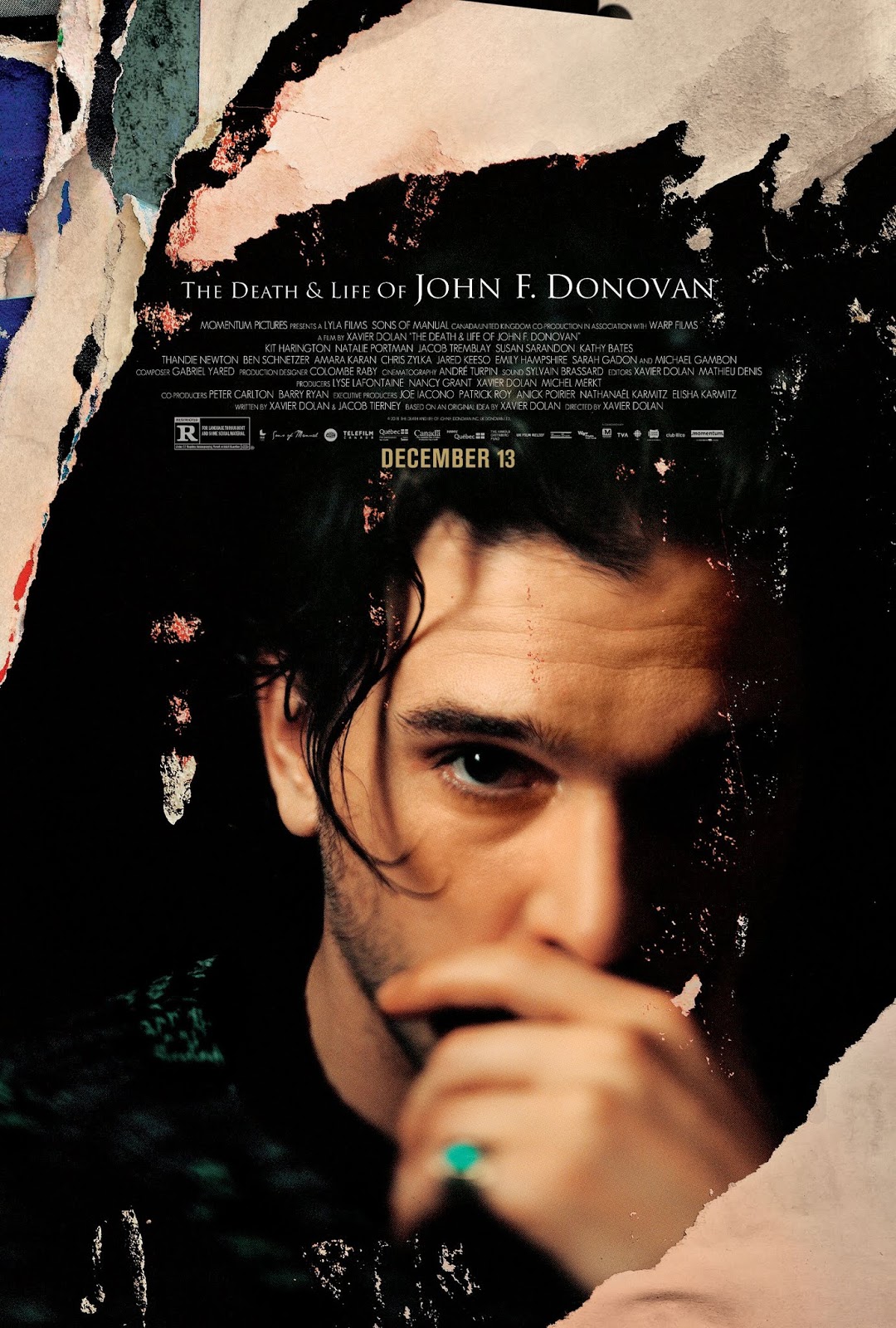
Xavier Dolan’s ‘Death and Life’ Matters


Watched an interesting film last evening called THE DEATH AND LIFE OF JOHN F. DONOVAN, a determined arthouse muddle that suffers for its ambition but is nonetheless a compelling watch that I'd recommend.

The film boasts an impressive cast: Kit Harrington (fresh off GAME OF THRONES), Susan Sarandon, Kathy Bates, Natalie Portman, Thandie Newton, Michael Gambon, Jared Keeso, Chris Zylka, Amara Karan, Ben Schnetzer, and an astonishingly good Jacob Tremblay (of ROOM fame). Jessica Chastain was also in the cast, but her part was excised from the final cut of the film in an effort by director Xavier Dolan to address issues with pacing and the film's running time.

In 2006, the title character (Harington) is a popular TV and movie star and the object of an 11-year-old aspiring thespian named Rupert's (Tremblay) devout fan worship. Rupert, an American expat living in England with his drifting, neurotic mother (Portman), is a precocious outsider struggling to fit in and subject to the cruel bullying by classmates that carries a strong undercurrent of homophobia. One source of comfort in his isolation is an unlikely (and clandestine) pen-pal correspondence he strikes up with Donovan and the string of handwritten letters they exchange over the five years before Donovan’s shocking tabloid-ready death.

The film totters back and forth between 2006 and 2017, as adult Rupert (Schnetzer)—also now an actor—publishes a book around the now-infamous correspondence and Rupert's interpretation of Donovan's tragically short life in the context of his writings. Using an interview with a reluctant journalist (Newton) in Prague, Dolan provides a serviceable—if somewhat anemic—framing device to recount the parallels and interconnected pasts of Donovan and the pre-adolescent Rupert.

Thematically, the film tackles quite a bit—the price of celebrity, familial resentment, the eternal struggle of self-acceptance at odds with the need for the acceptance of others, queer isolation, the impact that movies have in shaping our identities. It's a lot of philosophical meat to chew on, and this is where Dolan loses his storytelling grasp a bit. He seems determined to cram it all in and, unfortunately, some of the weightier themes get glossed over in his ambition. You’re left with the impression that Dolan’s film—despite its Chastain-erasing edit—would have benefitted from more time in the editing room. There’s also a nagging ambiguity about the epistolary relationship between Donovan and Rupert, with the impression of scandal hinted at but never delved into in any meaningful way. What was it about Rupert’s initial fan letter that caused an in-demand celebrity like Donovan to reply—and what was it in their subsequent letters that kept the correspondence going for years? These are questions that go frustratingly unanswered.

Visually, the film is a treat. Cinematographer André Turpin's sumptuous, burnished color palette and stylish camerawork lend a dreamy quality to the film. Likewise, the acting ensemble—particularly some of the supporting players here like Bates, Karan, and Gambon—grounds the film even when it threatens to go airborne with some of its loftier concepts. Sarandon, in particular, is excellent as Donovan’s alcoholic mother, even when her scenes splashing booze around threaten to descend into pure camp.

Despite its miscalculations, THE DEATH AND LIFE OF JOHN F. DONOVAN can be appreciated for Dolan’s confidence as a filmmaker. Although the cluttered fragmentation undermines the pace of the film at times, it also lends a surrealism that pulls you in. It’s a thought-provoking film that—despite how much it packs into its 123-minute running time—still feels unfinished. The film limps into the U.S. marketplace weakly in select theaters and VOD—arriving more than a year after its ill-received premiere at the 2018 Toronto International Film Festival—where I hope it finds some appreciation for the beautiful disaster it is.

Friday, March 8, 2019

Revisiting 'Amityville'


Among the sequel craze that started in the 1980s with Halloween and Friday the 13th, many might be surprised to learn that the modern-day horror film franchise with the most films to its name is The Amityville Horror. With a canon of 21 associated films (including sequels, reboots, and in-name-only knockoffs), The Amityville Horror franchise has eclipsed both Halloween (with 11) and Friday the 13th (with 12).
So it might come as a bit of a surprise when noted genre veteran Daniel Farrands—whose credits include screenplays for Halloween: The Curse of Michael Myers and the 2007 adaptation of Jack Ketchum’s The Girl Next Door, directorial work on a number of notable documentary features on film franchises like A Nightmare on Elm Street, Scream, and Friday the 13th, and numerous producer gigs—would mine the Amityville archives for his feature film directorial debut.
The Amityville Murders, which Farrands also wrote and produced, goes back to the real-life events that led to the original horror: The six gunshot murders at 112 Ocean Avenue, Amityville, carried out by Ronald DeFeo on the night of November 13th, 1974. DeFeo, in court testimony, claimed that voices coming from within the house drove him to kill every member of his immediate family. Although DeFeo was sentenced to (and remains in) prison, a mythos developed around the house itself when the Lutz family, who moved into the titular residence in late 1975, fled after less than a month because of the alleged supernatural events that served as the source material for Jay Anson’s bestselling 1977 book of the same name, which was based on about 45 hours of tape-recorded recollections from the Lutz family. The book became the ’79 film starring James Brolin, Margot Kidder, and Rod Steiger that went on to gross $86.4 million on a $4.7 million budget. In one of the longest-running acts of source material cannibalism, The Amityville Horror story has been artistically excavated, twisted and reconfigured, retold, and expanded upon for nearly four decades—with varying results.
Enter Farrands. Wisely, he opts to return to the scene of the crime—literally and creatively. Rather than add to the convoluted Amityville mythos, he chooses to revisit the story of Ronald DeFeo in what amounts to a proper prequel to the ’79 film. Diehard Amityville aficionados will note that 1982’s Amityville II: The Possession also attempted to loosely prequelize the pre-Lutz events, but Farrands’ outing is a more faithful retelling, coated with a nice period piece sheen.
The 1974 DeFeo’s are a suburban Long Island family whose outward picture-postcard success belies the dysfunction within. Patriarch Ronnie (an excellent Paul Ben-Victor) is the quintessential abusive husband and father, offering intimidation and beatings in private and paternal hugs in public. Wife and mother Louise (Diane Franklin) is that typical abused spouse who walks a fine line between trying to keep Ronnie’s rage at bay while facilitating some semblance of normalcy for her children. Eldest son Ronald (nicknamed “Butch”) is a directionless slacker and drug user while eldest daughter Dawn (Chelsea Ricketts) is smart, pretty, and protective of her older brother. There are three other siblings—Alison, Marc, and Jody—but they’re largely relegated to the periphery here, with Farrands choosing to focus his narrative on the DeFeo parents and their two oldest offspring.
Farrands spends time painting his cinematic picture of the DeFeo’s and their dysfunction—from Ronnie’s shady mafia dealings to Ronald Jr’s drug use and the especially volatile relationship between the two. At some point early on, both Lainie Kazan and Burt Young (who, in a nice wink to franchise fans, was also in Amityville 2 with Franklin) show up as Louise’s parents—with grandpa Brigante gifting Ronald and Dawn new cars on their shared birthday and Nona getting her hackles up when Louise casually mentions a possible West Coast relocation. “You’re going to sell my house?” she asks, practically drooling ill-omen. These early scenes are outstanding, even if the Long Island accents are a tad too exaggerated and the family’s Italian-Americanness bordering on caricature at times.
It’s revealed that Ronald Jr. and Dawn also mess around with the occult down in a little basement crawlspace with red cinderblock walls (aka the infamous “Red Room”). At some point, the dark forces within the house (it’s purported to be built upon land where the local Shinnecock Indian tribe had once abandoned their mentally ill and dying, an idea rejected by local Native American leaders) start their whispering through the walls and take possession of Ronald Jr. that culminates in the murders. The supernatural foreplay is effective although most of the visuals and set pieces will ring familiar to anyone who’s seen a Paranormal Activity film. Recycled but competent scares abound as the tension escalates.
Overall, The Amityville Murders hits its marks. Caveat: I’ve not seen a single Amityville film since the three-dimensional third so I may not be as jaded or franchise-weary as many reviewers seem to be. Farrands’s direction is solid, his pacing tight, and he really knows how to strikingly frame his shots. He also gets some major props for giving Diane Franklin a role befitting her talent. She’s been too-long relegated to shorts and subpar material in recent years for an actress of her stature and talent.
The standout here is John Robinson who does most of the film’s heavy lifting as Ronald Jr. He convincingly portrays a man slipping into madness, seamlessly shifting from anger and rage to vulnerability and melancholy with all the requisite raw emotion. It’s actually in considering Robinson’s performance where one might realize that Farrands missed a golden opportunity to muddy the waters a bit and aim higher with his franchise contribution. Instead of presenting the audience with a predetermined supernatural origin to Ronald Jr’s slip down the rabbit hole, layer in some ambiguity to suggest it might have been the drugs or PTSD from years of mental and physical abuse or even an undiagnosed mental illness like schizophrenia (the onset of which would correspond with the character’s age)—perhaps a combination of all these internal and external factors. When you make a movie based on real-life events and your audience knows the story’s ending from the outset, you need something else to make your mark. Leaving the audience pondering—and ultimately deciding for themselves—the origin of Ronald DeFeo’s eventual murderous snap would have added a decidedly cerebral element that would have elevated The Amityville Murders beyond the limits of its well-trodden zip code. 

Monday, February 26, 2018

The Cerebral Sci-Fi of 'Annihilation'

I've always been inspired by speculative fiction that makes you think. Case in point: Yesterday's screening of Annihilation. It was so refreshing to see a thought-provoking science fiction film that didn't mimic or remake anything that came before it. It's a cerebral film that treats its audience with respect and the presupposition that moviegoers are intelligent and focused enough to wade into a metaphorically-rich exploration of inward annihilation.
 
Challenging, tense, visually arresting, Annihilation is a thinking man's science fiction film ripe with heady ideas and layered with provocative thematic elements. Genetic malleability as villain is a terrifying body-horror concept that director Alex (Ex Machina) Garland nails brilliantly. Like the classic slasher convention the-call-is-coming-from-inside-the-house, the idea of the terror within is executed with precision, aided in large part by the film's acting ensemble. While Natalie Portman gives an astutely understated lead performance, it's Jennifer Jason Leigh's sublime turn as the expedition's psychologist leader and Gina (Jane the Virgin) Rodriquez's career-turning performance as a lesbian EMT that are the real standouts.
 
It's equally inspiring that instead of another remake or Alien knockoff, Annihilation was adapted from the first of three novels in the excellent Southern Reach trilogy (collected in the omnibus Area X) by Jeff VanderMeer. I sincerely hope that the female-led sci-fi actioner's fourth-place bow at the box office this weekend doesn't dissuade Hollywood from making more original genre fare, mining the rich supply of original speculative fiction out there hiding in plain sight in myriad novels and short stories instead of endlessly recycling uninspiring cinematic clichés.