It seems that the promotional machine behind the new Halloween hasn’t stopped since star
Jamie Lee Curtis took to Twitter in September of last year to announce that
Laurie Strode was headed back to Haddonfield. From the earliest teaser photo of
Curtis standing on a leaf-strewn porch in the same babysitter garb she donned
in the ’78 film with nemesis Michael Myers looking on, the franchise’s sizable fan
base has—quite literally—gone along for the ride from pre-production to
premiere. Momentum grew in earnest after the first trailer dropped and reached
fever pitch after the film’s premiere at the Toronto International Film
Festival. The promotional buzz has been deafening, and Curtis has so often and
so eloquently now articulated both her gratitude for the career that
Carpenter’s original gave her and the new film’s feminist timeliness in the
#MeToo era that diehard fans could probably recite her answers to interview
questions like lines from a script.

Logically, with such buildup comes expectation. And meeting
those expectations would be a monumental task for any director of any film—let
alone an unproven genre director who’s boldly taken on an iconic horror
franchise with a fiercely loyal (and hyper critical) fanbase. Even with the
blessing of the film’s original director and co-screenwriter and the all-in
participation of, arguably, the most popular and recognizable scream queen in
film history, success in the age of the armchair critic and Internet mob rule
will be an uphill battle for David Gordon Green’s Halloween. For as eager as fans were for a new addition to the
venerable franchise, they’re also loyalists and experienced genre veterans.
Just as film scholars have come around to give Carpenter’s Halloween its rightful due, horror movie fans who grew up on the
’78 film and its countless knockoffs have hardened, grizzled a bit, and,
perhaps, become slightly more discerning in their tastes.
The last time we visited Haddonfield, Michael Myers got a
backstory, someone else was playacting Laurie Strode, and fans were
polarized—like Clinton versus Trump-level polarized. Indeed, Rob Zombie’s
revisionist take on Carpenter’s source material in 2007, and then again in
2009, is still the stuff of much debate and deliberation—and sometimes raw
emotion. Prior to that, we endured the largely unwatchable Resurrection outing in 2002—helmed by the original 1982 sequel’s
director, Rick Rosenthal—that saw Laurie Strode die within the first ten
minutes of the movie and Myers go on to terrorize Busta Rhymes and Tyra Banks.
That trainwreck was preceded by the decidedly more watchable—and arguably one
of the best—H20 installment. That
film came 20 years after the original and took on much of the narrative that
Green’s Halloween takes on two
decades even further in—how does Laurie Strode fare after the fateful events of
Halloween night, 1978? Going back even further than Halloween: H20, there were another four direct sequels to
Carpenter’s film and one weirdly standalone film when Carpenter and Halloween co-writer/producer Debra Hill had
thoughts of the series branching into an anthology series centered around the titular
holiday—long before American Horror Story
revolutionized the anthology concept. The Halloween
franchise now consists of eleven films and stands—pre-release of the 2018
outing—as the fourth highest-grossing domestic horror franchise at approximately
$668 million.
Not to put too fine a point on this, but David Gordon
Green—who shares co-writing credit with Danny McBride and Jeff Farley on the
new Halloween’s script—had his work
cut out for him long before the cameras rolled. History, expectation, and
nostalgia are strong forces in the universe of fandom. So, how’d he do? Let’s
examine.
The first smart choice Green makes—and, ironically, his most
controversial—is to fashion the new Halloween
as a direct sequel to the ’78 film. That’s right: No hospital massacre, no
sibling ties, no Jamie Lloyd, no faked death and headmistress gig, no fall off
the sanitarium roof. Just Laurie sobbing on the floor declaring to Dr. Loomis
“It was the bogeyman” and a
forty-year flashforward. Interestingly, it’s not the first time the franchise
retconned a timeline; H20 jettisoned
the events of the fourth, fifth, and sixth films. This retroactive continuity
allows Green and company to reset the clock and imagine a new series of events
not mired in the myriad inconsistencies and questionable creative decisions of
previous films in the series. And—color me crazy—but I find it vaguely
comforting to know that Nurse Chambers never met the end of Michael’s butcher
knife after all and picture her chain-smoking on a porch somewhere with a
faithful Golden Retriever at her feet while she waits for a carload of
grandbabies to visit(!).

In the 2018 version of Halloween,
we’re re-introduced to the two central figures in the series—Michael Myers and
Laurie Strode. Myers is revealed to have been apprehended and captured after
the events of ’78, locked up in Smith’s Grove Sanitarium ever since. For all
intents and purposes, his life and murder spree ended as if someone hit the
pause button. Conversely, Laurie has lived forty years’ worth of life—she’s
married and divorced twice, had a daughter, and now has a granddaughter—but
it’s been a life irrevocably altered and affected by what’s come to be largely
forgotten and relegated to an anecdotal footnote in Haddonfield’s history. Myers
may be the one physically imprisoned, but Laurie’s been mentally held captive
by the trauma of “the Babysitter Murders” for four long decades. We see the toll her PTSD has taken—from her
estrangement from the daughter taken away from her to the labyrinthine compound
of traps, triggers, and panic rooms she’s rigged together. She’s a woman lying
in wait, confident in her intuition that Myers will come for her again—even if
everyone else from the local townsfolk to her own family have come to discount such
certitude as the ravings of a damaged woman. She’s like the survivalist version
of the neighborhood crazy cat lady.

Green chooses to re-introduce us to Myers first during a
gorgeously shot sequence in the enclosed courtyard of Smith’s Grove. Two
ill-fated British true-crime podcasters are there to interview him on the day (aka Halloween eve) he’s to be transferred to an out-of-state maximum-security facility. We’re introduced to his new psychiatrist, Dr. Sartain (Haluk
Bilginer)—or the “new Loomis” as Laurie snarkily dubs him later—who’s a poor
stand-in for Donald Pleasance. After inciting everyone but Myers with his old
mask and histrionic pleas to “SAY SOMETHING, MICHEAL!”, the podcaster pair set
off—post-opening credits—to interview the lone survivor of Myers' murderous
rampage. Deep in the woods, locked behind sliding gates, steel-reinforced doors, and
more deadbolts than you can count, we get our first look at this older, damaged
version of Laurie, who’s apparently as short on patience as she is on cash.

We eventually meet the other key players, including daughter
Karen (Judy Greer), son-in-law Ray (Toby Russ), granddaughter Allyson (Andi Matichak),
and Allyson’s assorted besties—Vicky (Virginia Gardner), Vicky’s boyfriend Dave
(Miles Robbins), her boyfriend Cameron <wink-wink> Elam (Dylan Arnold), and Cameron’s best bud Oscar (Drew Scheid). Introductions
are cursory at best because—as horror diehards know well—cast of characters in a slasher film is little more than code for body count. And Green doesn’t disappoint
in that facet of the film.
Laurie is barely finished with her Annie Oakley-style target
practice (complete with every leftover mannequin from the prop closet of Tourist Trap it seems) when Michael’s
transfer goes not-shockingly-but-necessarily awry. Carpenter’s updated iconic
score kicks in and Myers is back on the streets of Haddonfield, slicing his way
through town before an incoherent, annoyingly convenient, and completely
out-of-left-field twist delivers him to Laurie’s well-lit doorstep to kick off
the film’s third—and most satisfying—act. Suffice to say that it takes a
village—or at least three generations of well-armed women anyway—to bring
Myers’ reign to its simultaneously inevitable and questionable end. It’s
kickass, well-paced, and loads of fun; the audience I saw it with was screaming
and cheering.

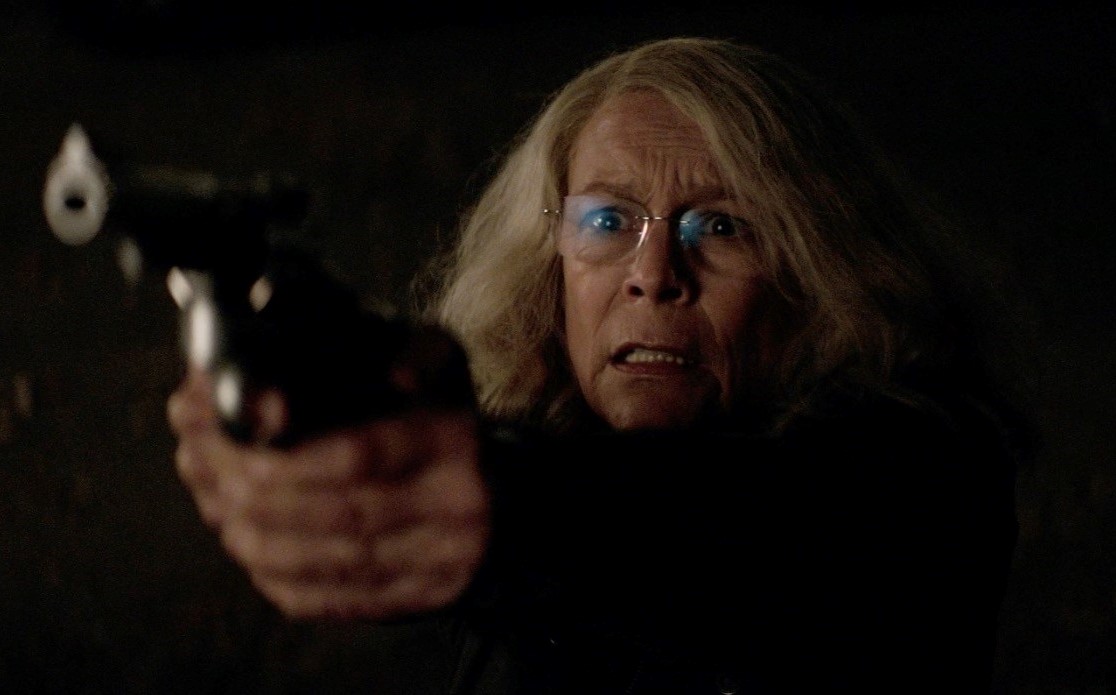
Curtis delivers the goods and is the heartbeat of the film.
This is a movie about a victim weary of being a casualty of her shared history with
her aggressor. Laurie has painstakingly prepared and patiently waited for forty
years—at great personal sacrifice—to reclaim her narrative, and Curtis’ performance reflects that well-worn resolve. She’s nothing short of a
marvel—particularly in a scene where she waits outside the sanitarium in her
pick-up truck, gun in one hand, booze in another, and watches until Myers is
loaded onto the bus and pulls away. Her face conveys everything the character
has suffered and lost—pain, rage, vulnerability.

There are three standouts in the supporting cast: First,
Andi Matichak who does a competent job essentially portraying Laurie’s younger
self. As Allyson, Matichak embodies the quintessential high school girl—an updated
Laurie Strode, if you will—with enough presence to be memorable without
overshadowing the character she’s modeled after. Although this Halloween doesn’t
give her the screen time that the original gave Curtis, she still manages to leave
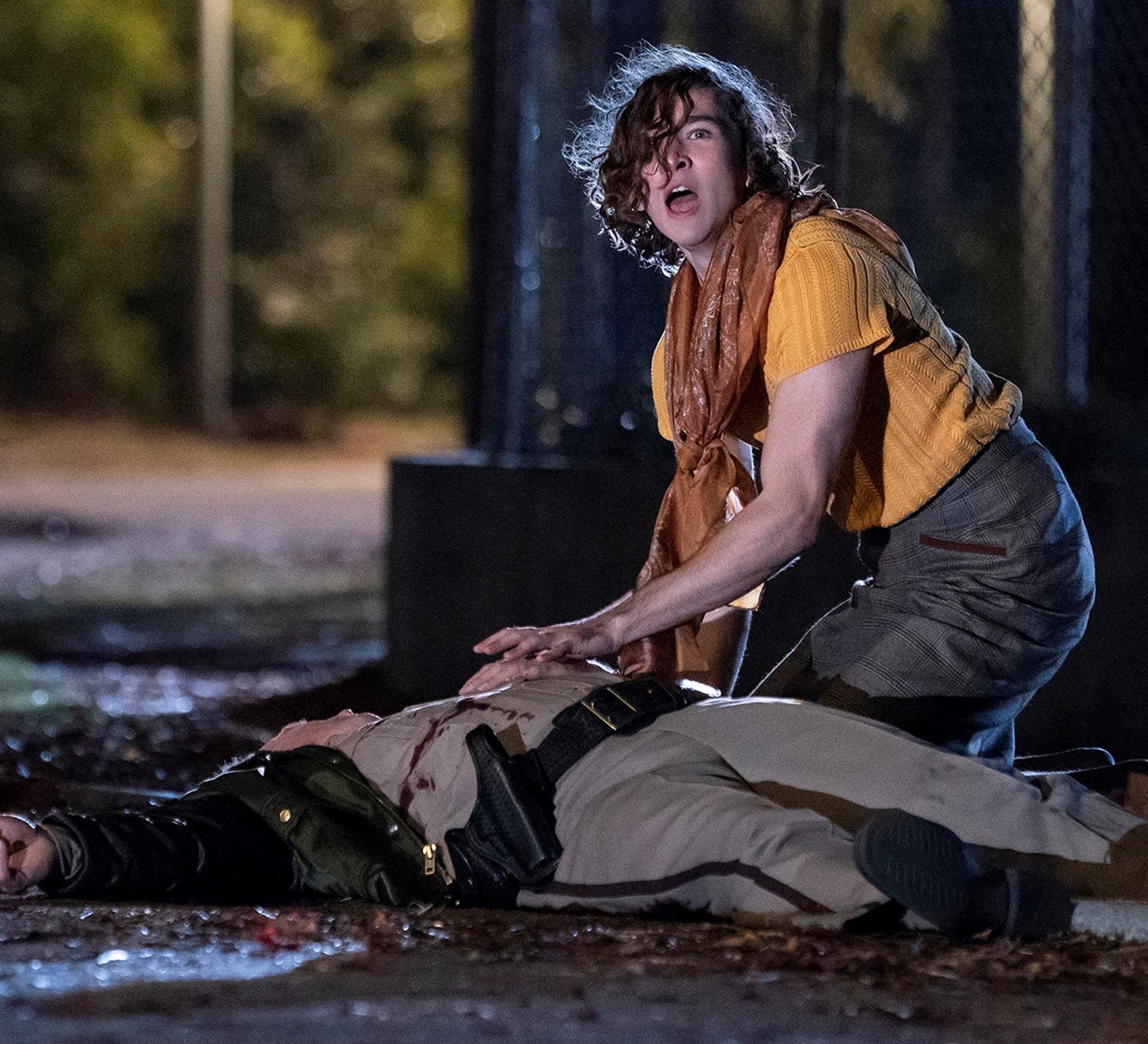
her mark. The second standout is veteran character actor Will Patton. As Haddonfield’s
current lawman Officer Frank Hawkins, Patton is given a sizable role on point
with that of Charles Cyphers, who played Haddonfield’s original sheriff in the
1978 film. He’s believable and likable and really lends solid support, especially
in his scenes with Curtis as you see his reluctant transition from someone who
fell squarely into the camp who dismissed Laurie as an eccentric to someone who
now—with equal reluctance—realizes that she was right all along. Finally, Judy
Greer gives a beautifully nuanced performance as Laurie’s adult daughter, who
herself has been the victim of generational trauma. On the surface, it first
appears that Greer is given yeoman’s work here but watch a little closer and
you’ll see an exquisitely subtle rendering of a daughter grappling with the
necessity of self-preservation against the strength of familial bonds. It also
doesn’t hurt that Greer gets, arguably, the best line and cheer-worthy moment in
the movie.

Overall, Green delivers the requisite slasher goods. The
film’s post-Myers’ escape pacing is spot-on, and the body count is suitably
upsized from the film’s 1978 counterpart, which is cleverly acknowledged as
being tame by today’s standards in the film. He does an exceptionally good job
of liberally sprinkling in Easter eggs for the franchise’s faithful—almost two
dozen by count—without pulling the new Halloween
out of the present and into the past. This reviewer isn’t sure that the casual
viewer (or even the diehard fan for that matter) will realize what a tricky balancing
act this is. After all, with forty years of history, it would be a missed
opportunity not to pay tribute in some way to what precedes Green’s film;
conversely, done too obviously or without careful regard for tone and pacing,
viewers could be pulled right out of the film. Wisely, Green limits most of his
Easter eggs to visual references—sheets hanging on a clothesline, familiar
rubber Halloween masks, a closet with louvered doors, a memorable tombstone, a
hastily drank glass of wine—and eschews actor cameos (with the brilliant exception
of one vocal cameo by a member of the original film’s cast). Sure, I still think
Kyle Richards’s adult Lindsey Wallace bumping into Curtis’ character on the
street while trick-or-treating with her kids would have been brilliant, but I
give Green credit for resisting the easy and obvious stunt cameos.
Again, with forty years investment in the franchise—its characters,
its storylines, its hits and misses—it would be easy to nitpick the hell out of
the new Halloween. After all, who
knows the film better, more intimately than its loyal fanbase whose affection
for the series rivals the generational affection of any sports fan for a
particular team? I’ll limit my criticisms to those I felt actually detracted
from the film—as made—versus any personal projection of what should have been
done/included.

My chief grievance is the film’s uneven editing. There are
scenes—important scenes like the one with Curtis, solo, in her truck—that are
cut so abruptly that they’re jarring. It leaves the finished film feeling like
there was too much to cram into some subjective studio-mandated running time constraint.
No doubt the film’s future home video release may shed some light on what was
cut and how—or even if—the trimmed footage changed the movie’s original footprint.
My second beef is the inclusion of too many unnecessary characters—chief among
them Sheriff Barker (Omar Dorsey) whose wholly pointless presence seems purposed
only to fill an arbitrary diversity quotient and whose ridiculous cowboy hat to
remind us that we’re in the Midwest. Third, Green’s film has been woefully shortchanged
by the film’s marketing. Too many trailers showing way too much footage
(including some footage that obviously fell victim to the editor’s hacksaw). Forget
what I said a moment ago about ruminating on the should’ve, could’ve, and would’ve.
The studio should have literally let Curtis talk the movie up the way she has
with virtually nothing but perhaps a single trailer with flashes of images. Less
would have been infinitely more here. Audiences know—or can easily deduce—the entire
storyline going in. That lends itself to the problem of expectation mentioned
earlier. Truly brilliant marketing would have been to let audiences walk in
blind, having only Curtis’ well-articulated treatise about post-generational
trauma in their heads as they settled into their multiplex seat to watch the
movie.
Lastly, and ideally, I would have liked to have seen a new Halloween that was relentlessly grim and
frightening. Yes, I know in the post-Scream
era that horror films—especially slashers—are required to infuse humor in
between the murder and mayhem. But why? As films like The Descent and The Witch
and The Babadook and Hereditary have shown us, it’s ok to just
go for the jugular and scare the living shit out of an audience. Horror
audiences are a durable bunch who don’t need chuckles sandwiched between the
jump scares. Halloween, circa 1978,
worked so well and has endured because Carpenter understood that. Any laughter
elicited was nervous laughter. Tommy Doyle and Lindsey Wallace added to the
tension with their childhood fears, not detracted from it with precocious
one-liners like (the admittedly adorable) Jibrail Nantambu’s Julian does. His Webster-like comedy schtick just undermines
what should have been a horrific, traumatizing scene.
And there you have it: David Gordon Green’s Halloween is an enjoyable, if imperfect,
roller-coaster ride that does what it sets out to. Buoyed by a franchise-best
performance from Curtis, some impressive set design and cinematography that
captures the essence of the titular holiday, and an altered timeline that
simplifies matters and brings the proceedings back to the spirit of Carpenter’s
original, the new Halloween is a respectably
solid addition to the Michael Myers mythos. Like time proved ultimately kind to
Carpenter’s original—hey, even The New
York Times recently gave the original film a proper review after a
forty-year oversight—years and endless analysis will ultimately give Green’s
film its rightful ranking within the franchise canon. For now, go see it—have a
laugh, scream a little, cheer a lot. There’s something cathartic about watching
a woman long-scorned taking names and kicking ass in this revitalized feminist age.
Plus, it’s Halloween—everyone’s entitled to one good scare,
no?