Pages

Showing posts with label Movie reviews. Show all posts

Sunday, April 17, 2022

The Transcendent Chaos of ‘Everything Everywhere All at Once’

Be forewarned: There is no way to adequately craft a proper review of Everything Everywhere All at Once without an inordinate number of adjectives and other qualifiers. In fact, it would likely be easier to create an extensive list of adjectives—with adverbial modifiers to drive the point home—to critique this extraordinary achievement in American filmmaking.

Everything Everywhere All at Once is the bombastic brainchild of the directing duo collectively known as Daniels—Dan Kwan and Daniel Scheinert. The filmmakers previously helmed the 2016 surrealist comedy-drama Swiss Army Man, which saw Daniel Radcliffe playing a corpse with propulsive flatulence and an erection that doubles as a compass. Daniels bring that unique brand of off-kilter kookiness to their latest effort and then turn the sensory overload dial way up past the point of no return. Daniels effectively throw everything and the kitchen sink at the wall and—remarkably and improbably—everything sticks, everywhere, and (yes) all at once.

The incredible Michelle Yeoh toplines as Evelyn Wang, a Chinese-American immigrant and laundromat owner who, while being audited by the IRS, discovers that she must connect with different versions of herself from parallel universes in order to prevent the destruction of them all by an evil entity known as Jobu Tupaki. That’s a dramatic oversimplification of the plot, which also has Evelyn grappling with her daughter’s sexual orientation, learning of her husband’s petition for divorce, and stressing over the arrival of her judgmental father (the legendary James Hong) from China. Looming over all of it is frumpy, humorless IRS inspector Deirdre Beaubeirdra (Jamie Lee Curtis), who warns of foreclosure and repossession due to Evelyn’s woeful mismanagement of the business’ taxes.

Through a variant version of her husband, Waymond (The Goonies Ke Huy Quan all grown up), Evelyn learns that every choice made creates a new universe; these innumerable parallel universes make up the multiverse. In order for Evelyn to defeat Jobu Tupaki—a version of her daughter, Joy (The Marvelous Mrs. Maisel’s Stephanie Hsu) who’s capable of experiencing all universes at once and manipulating matter at will—she must repeatedly “verse-jump” and connect with the different versions of herself to access the skillsets and memories of her parallel universe counterparts. But there is inherent danger in verse-jumping with such abandon; Evelyn risks splintering her mind, which is what drove a once benign version of her daughter to become the self-hating Jobu.

In her many verse jumps, Evelyn sees how her life would have turned out having made a single different choice. In one, she’s a glamorous martial arts movie star who encounters a sophisticated version of a Waymond she left and never married—one who now rejects her. In another, she’s a lesbian married to Dierdre, in a bizarre world where humans have hot dogs for fingers and play the piano with their toes. In yet another, she and Joy are merely two rocks with googly eyes living on the edge of a cliff. Daniels excel at creating madcap, boundary-pushing dreamscapes within these multiple realities existing at once within the known realm of time and space.

Within their evocative and cacophonous labyrinth of storytelling, the directors employ an anything-goes audacity—a swirling cyclone of fertile ideas and heady concepts—and straddle the worlds of science fiction, comedy, drama, action, and martial arts. The nearly two-and-a-half-hour film moves at a frenetic pace, with nonstop martial-arts action and in-your-face slapstick that allow for no bathroom breaks. (Word to the wise: Only buy the small soda and sip judiciously). Despite the complexity of their convoluted plot, Daniels admirably keep things surprisingly coherent—even the technobabble makes sense.

Yet, despite its massive interdimensional scope, Everything Everywhere All at Once is surprisingly intimate in scale. Even as the film slingshots between realities, somewhere between super-powered pinky fingers and weaponized butt-plugs, its absurdity is matched only by its heart. While you’re strapped in and relinquishing yourself to the cathartic rush-release of Daniels’ delightfully gonzo rollercoaster ride of psychedelic visuals and bold tonal shifts, you don’t expect the film’s emotional core to sucker punch you so hard by the end. With its larger, overarching message about kindness being the strongest weapon, it’s a story of human connection explored here in the conflict and reconciliation between an Asian mother and daughter who learn to cherish each other again.

Anchoring that emotional core is Yeoh’s Herculean performance. The film reads like a love letter from Daniels to the 59-year-old actress, who’s given what’s easily the best role of her career. Yeoh adeptly juggles the myriad nuances of Evelyn’s multiverse counterparts with aplomb, never losing track of who she’s supposed to be at any given moment. That she’s able to play so many versions of, essentially, the same character is no small creative feat. She effortlessly switches from comedic to dramatic, from martial arts maestro to overwrought mother, without missing a single beat anywhere in the film. Yeoh’s Evelyn shows us that even when you feel like you are the worst possible version of yourself, there is hope.

Likewise, the film’s supporting cast is a treat. Arguably, Quan does as much heavy lifting as Yeoh, especially in being tasked with having to explain the more technical aspects of Daniels’ plot. Hsu is a pure joy (pun intended) as both disaffected twenty-something daughter and as the colorful, villainous embodiment of all that disaffection. (Fun fact: Hsu got the role after Awkwafina dropped out due to scheduling conflicts.) Hong, a legend in his own right, lends gravitas to his role as Evelyn’s father and it’s a hoot to see him deployed in the multiverse. Tallie Medel as Becky, Joy's girlfriend, also makes the most of what could have been a pedestrian role. Curtis, who’s become so comfortable in her own skin as an actor as she’s matured, is a real scene-stealer here. In the hands of a lesser actor, her crotchety Dierdre could have been played as a one-note comic relief character, but Curtis imbues her with so many subtle humanities, that she elevates Dierdre beyond the periphery. There’s a scene between Evelyn and Dierdre outside the laundromat toward the end of the film that is utterly pitch-perfect and shows why these two women are Hollywood royalty.

My only beef with Everything Everywhere All at Once has nothing to do with the film itself and more to do with its distributor, A24. Arguably one of the most ambitious and prestigious film outfits out there today, I’m baffled why they chose to release this virtuoso cinematic triumph so early in the year. My fear is that the film will be overlooked come awards season later this year—and that will be nothing short of criminal. The film, its directors, its screenplay, its score by Son Lux, Larkin Seiple’s cinematography, its countless technical achievements, and at least three of its actors—Yeoh and Quan in lead acting categories, Curtis in supporting—should all receive nominations from multiple awards bodies. I hope the members of these various awards institutions will remember this masterpiece film a few months from now amid the noise of the year-end slate of “prestige” films that take over the narrative leading up to nominations.

Somewhere between death and taxes are beautiful moments—and these brief snippets of time are what make life worth living. This is the essence of Everything Everywhere All at Once and Daniels—aided immeasurably by Yeoh and their ensemble—employ an unmatched artistic aptitude in bringing their vision to whimsical, technicolor life. It’s a masterclass in filmmaking that will enthrall you with its exquisitely choreographed martial arts sequences before bringing tears to your eyes with the weight of its profound questions and truths about life. Unlike anything you’ve seen before, Everything Everywhere All at Once is destined to become a classic, an amalgamation of genre anarchy that defies classification, subverts expectations, and explores existential matters with empathy and insight. This marvelously unhinged slice of cinematic maximalism is nothing short of a work of art—and not to be missed.

Just let go—and let Yeoh. 

Sunday, February 20, 2022

Buckets of Blood and Gerontological Madmen in 'Texas Chainsaw Massacre'

Horror fandom is a curious thing indeed. This week’s bemusement has been watching the horror faithful on social media extolling the original The Texas Chainsaw Massacre—the story of young people from out-of-town trespassing on other people's property and getting butchered by a chainsaw-wielding maniac named Leatherface—as a virtuous classic while in the same breath decrying the new TCM—a  story about young people from out-of-town trespassing on other people's property and getting butchered by a chainsaw-wielding maniac named Leatherface—as the stupidest thing they've ever seen. It's literally the same plot, just updated. It’s hard not to laugh out loud at the computer screen some days. I’m reminded of the tagline from Wes Craven’s The Last House on the Left: “To avoid fainting, keep repeating, ‘It’s only a movie…’”

So, let’s unclutch those pearls and talk about the latest installment in the franchise that began with Tobe Hooper’s gritty 1974 slasher. Texas Chainsaw Massacre (the ’22 film drops the “the” from its title) is directed by David Blue Garcia, with a screenplay by Chris Thomas Devlin, from an original story co-written by Fede Álvarez (also a producer on the film) and Rodo Sayagues. Originally, the production began with brothers Ryan and Andy Tohill (who directed 2018’s The Dig) at the helm, but the directors were replaced with Garcia after studio displeasure with the footage they shot. That’s never a good sign.

Ripping a page from the playbook David Gordon Green used for his 2018 relaunch of the Halloween franchise, the new Texas Chainsaw Massacre serves as a direct sequel to the original film—however it doesn’t necessarily retcon the sequels the way Green’s film trilogy does, with Álvarez stating in interviews that it's up to audiences “to decide when and how the events of the other movies happen.” Fair enough—and who cares, anyway, right? To tackle direct sequel problem #1—the 2014 death of Marilyn Burns, who played TTCM Final Girl Sally Hardesty—the filmmakers cast Irish actress Olwen Fouéré, an especially accomplished stage actor with about a dozen movie and TV credits each to her name. It’s excellent casting and Fouéré does the best with what she’s given; unfortunately, she’s not given anything other than a watered-down version of 2018’s Laurie Strode. To tackle direct sequel problem #2—the 2015 death of Gunnar Hansen, TTCM’s original Leatherface—Mark Burnham was cast in the role of the iconic horror villain. Burnham does a most respectable job given the big shoes he has to fill, but of course his character’s agility and stamina at (at least) age 70 requires a huge suspension of disbelief. Suffice to say that 2022 Leatherface is one fast, strong-ass motherfucker.

The new film opens as San Francisco speculators Melody (Sarah Yarkin) and Dante (Jacob Latimore)—with Melody's sister Lila (Elsie Fisher) and Dante's girlfriend Ruth (Nell Hudson) along for the ride—travel to the remote, long-abandoned Texas town of Harlow. Melody and Dante plan to auction off the town’s properties to create a trendy, heavily gentrified area for hipsters of every persuasion. Why, you ask, would said trendy hipsters with ample cash to burn pick an out-of-the-way, hot-as-Satan’s-ass locale like bumfuck Texas as an investment opportunity? No one really knows—and Lila even questions it aloud at one point in the film.

Upon the foursome’s arrival, they discover that one of the buildings—the town’s orphanage—is still occupied by the elderly Mrs. Mc (a welcome cameo by the wonderful Alice Krige) and a silent, towering older man. While enjoying some sweet tea provided by the congenial Mrs. Mc, a kerfuffle over who holds the rightful deed to the orphanage breaks out—and ends with Mrs. Mc suffering a heart attack. Fearful of the bad publicity, Ruth offers to accompany the sheriff and his deputy as they transport Mrs. Mc—and the not-so-mysterious hulking man—to the hospital. En route to the hospital, things go awry—so much so that hulking mute guy goes ballistic, kills almost everyone in the emergency rig, and peels the face off one of them. Leatherface is back—and he’s pissed. Cinematographer Ricardo Diaz shines in this gorgeously shot scene that has Leatherface standing in a field of dead sunflowers, holding up the skin of his new face. Ruth, who’s injured but alive, witnesses the rebirth of Leatherface and manages to get a radio transmission off before she’s (literally) gutted by him.

As Leatherface makes his way back to Harlow, a charter bus full of potential investors arrives and the property auction ensues. As word of Mrs. Mc’s death makes it back to Melody via Ruth’s last text before Leatherface’s ambulance ambush, local contractor Richter (Moe Dunford) hears her and Lila talking about it and takes Melody and Dante to task for causing Mrs. Mc’s heart attack and subsequent death. He confiscates the keys to the bus and their sports car, demanding proof that they had the right to evict Mrs. Mc before he’ll give them back. Discovering they don't have the deed showing they own the orphanage after all (oops!), Melody and Dante return to the creaky home for wayward boys to find it. Elsewhere, Sally Hardesty—her long grey hair and tank top giving us immediate Laurie Strode vibes—takes a call from the local gas station clerk who received Ruth’s last radio transmission, and he informs her that Leatherface is back. She arms up and heads out, adding an awesome cowboy hat to her survivor ensemble to perfect effect.

It's not giving too much away to say that Leatherface makes his way back to Harlow in what seems like record time and resumes his titular massacre once again. There are some over-the-top set pieces here—one of them pushed to the point of pure camp—and gorehounds will delight in the plethora of practical special make-up effects. The film is lean (at one hour and twenty-three minutes) and meaner than a rabid dog in the midday Texas sun getting poked repeatedly with a big stick. It’s all a heck of a lot of fun, even if the creative forces miss the boat almost entirely with the Sally Hardesty character. What could have been an awesome final chapter for survivor Sally is reduced to a mere sidenote, largely wasting Fouéré’s considerable talent. If anything, Texas Chainsaw Massacre reminds us how very important—crucial even—writers are to what we see and experience onscreen.

No, none of the characters are particularly memorable nor do we care when it’s their turn to meet the end of Leatherface’s chainsaw. No, making this film’s Final Girl a school shooting survivor adds nothing of note to her character or the plot. No, Leatherface’s speed and agility don’t make a lick of sense in the context of his chronological age. But 2022’s Texas Chainsaw Massacre is a lot of fun despite its myriad flaws—in that kind of mindless Saturday matinee, popcorn movie kind of way.

How best to enjoy this latest entry in the venerable horror franchise? Let go and let Garcia. 

Sunday, June 7, 2020

Review: ‘Scream, Queen! My Nightmare on Elm Street’


I finally had the opportunity to catch Scream, Queen! My Nightmare on Elm Street, the documentary that explores the infamous homoerotism of the first sequel to Wes Craven’s 1984 classic A Nightmare on Elm Street. Co-directed by Roman Chimienti and Tyler Jensen, this heartfelt documentary examines this aspect of the oft-maligned ’85 sequel in a unique way—by focusing on the human toll the film’s reputation took on its leading man.

Mark Patton was just 25 when he was cast as the lead in A Nightmare on Elm Street 2: Freddy’s Revenge, quite the professional coup after leaving home in the Midwest at 17 to pursue his dreams of a career as an actor. Patton’s all-American good looks led to immediate bookings in national commercials, with his big break coming shortly thereafter when he landed a plum supporting role in the Broadway play Come Back to the Five and Dime, Jimmy Dean, Jimmy Dean, directed by Robert Altman and starring Cher, Sandy Dennis, Karen Black, and a pre-Misery Kathy Bates—a role he repeated in the subsequent film version. By the time he landed the role of Jesse Walsh in the Elm Street sequel, Patton—who was gay and closeted, as the times dictated—had moved out to Hollywood where he met and began a relationship with Dallas actor Timothy Patrick Murphy.

Despite its commercial success, Freddy’s Revenge was widely derided and eventually became known in the early days of Internet film analysis as "the gayest horror movie ever made." Although time—and evolving social mores—have been kind to the film and elevated it to the status of a cult classic and even revered because of its not-so-subtle-after-all gay subtext, Patton’s career became collateral damage. The actor was wrecked by the negative response to the film and comments about his performance. Following an episode of Hotel and a CBS Schoolbreak Special, in which he co-starred—ironically—with A Nightmare on Elm Street final girl Heather Langenkamp, his acting career came to an unceremonious end. His personal life was no better—Murphy would die, tragically, of AIDS in 1988 at the age of 29 and Patton’s own HIV-positive diagnosis would eventually follow, complicated when he came down with tuberculosis. He left Hollywood in due course upon his recovery, retreating down to Puerto Vallarta, Mexico, where he entered into decades of self-imposed exile—albeit with some newfound personal happiness in the form of a husband and an art store, where he sells works of his own creation, including a line of painted handbags he designed.

In 2010, Daniel Farrands, director of the exhaustive Elm Street documentary Never Sleep Again, tracked Patton down and entreated him to speak openly about his experiences and his legacy as part of the iconic film franchise. It was during his participation in Never Sleep Again that Patton came to realize just how dramatically the critical and cultural tide had begun to turn in favor of Freddy’s Revenge, with the film now hailed for the very thing that had caused him so much past anguish. Patton found himself applauded across the horror convention circuit, and that led to his desire to get his life story out into the world by developing a film (then) called There Is No Jesse. Unbeknownst to him, he would soon cross paths on social media with two aspiring filmmakers with a shared love for A Nightmare on Elm Street 2—and four years later, the trio gifts fans with Scream, Queen! My Nightmare on Elm Street.

Chimienti and Jensen have crafted a polished and engaging documentary, utilizing interviews, archival footage, and a “day-in-the-life-of” approach as they follow Patton from one convention to another. Although the documentary threatens at times to burst at its seams with all that the filmmakers earnestly include here, it’s Patton—the film’s center—who grounds the proceedings with his candid, sometimes achingly bittersweet recollections of his journey. Watching Scream, Queen! My Nightmare on Elm Street, I found myself raging at times over the homophobic inner-workings of the Hollywood machine during the AIDS plague, cheering for Patton’s self-discovery and journey to reclaim his legacy at others. It’s hard not to find yourself in a puddle of tears watching how Patton is revered by the Elm Street fans and to feel the palpable sense of empowerment as he takes to the stage to rightfully affirm his place as horror’s original “final boy” while embracing the “scream queen” title that was once weaponized against him. 

The central conflict of the documentary is framed between Freddy’s Revenge screenwriter David Chaskin and Patton, with the latter holding firm to the claim that Chaskin disingenuously skirted responsibility for the film’s overtly gay subtext. Chaskin long-maintained that it was Patton’s performance that was responsible for the film’s gay overtones that unsettled audiences upon its release, even going on record with the proud admission that his screenplay was meant to be homophobic versus homoerotic. In this 2007 interview with Bloody Good Horror, Chaskin says:

“Yes, there was certainly some intentional subtext but it was intended to play homophobic rather than homoerotic. I thought about the demographics for these types of films (young, heterosexual males) and tried to imagine what kinds of things would truly frighten them, to the core. And scary dreams that make them, even momentarily, question their own sexuality seemed like a slam dunk to me.

If you really wanted to have fun, one might argue that the entire movie is a metaphor—Jesse is, in the end, finally able to control the monster inside him (his latent homosexuality) with the love of a good woman. Maybe they should show this film at one of those evangelical deprogramming sessions where they try to ‘fix’ gay people into regular Americans.

That said, there were certain choices that were made (e.g., casting) that, I think, pushed the subtext to a higher level and stripped away whatever subtlety there may have been. To this day, Jack Sholder says he read no such subtext into the script. It must have been by osmosis. At any rate, he should have seen it coming—when we opened in New York, we got a rave review in The Advocate.”

It’s here—with the resolution of this central conflict—that my one and only criticism with this otherwise pitch-perfect documentary comes into play: Chimienti and Jensen should have skipped it. It falls flat and lacks the requisite catharsis necessary to resolve the focal tension the film devotes much of its 99-minute running time to exploring. What should play as a pivotal moment in Patton’s liberation from this emotional shackle that he’s carried with him for more than three decades comes across as anticlimactic, with Chaskin’s “apology” being anything but. It’s a jarring moment of insincerity in what’s been nothing but a pervasive sense of sincerity throughout the rest of the film. Even Patton looks nonplussed. It’s an awkward scene that fails to give the audience the payoff it’s expecting—and the moment of unequivocal apology that Patton deserved.   

Yes, Chaskin is an asshole for intentionally injecting homophobia into his script, but I found Freddy’s Revenge director Jack Sholder far more culpable for his part in dodging accountability—and almost insultingly so. The film—as in, the one Sholder directed—includes a sequence in a gay bar (that was shot in an actual gay bar!), frequent male nudity, crotch shots, and glistening male chests, a bare-assed towel-whipping of a naked restrained man in the shower, a scene in which Freddy Krueger caresses Jesse's face before suggestively sticking a clawed finger in his mouth (which actor Robert Englund even admits was meant to be homoerotic), Patton in tighy-whities, Patton in a jockstrap, and Patton's butt-bumping solo dance to “Touch Me (All Night Long)” by Wish featuring Fonda Rae. That Sholder can claim no knowledge, no awareness of the gay subtext in his own movie is maddening to watch—especially in a later scene in which he basically tells Patton that it’s time to “get over it.” I was left shouting “WTF?!” at my television and wanting to throw the remote at Sholder’s clearly dishonest attempt to remove himself from any semblance of answerability by claiming naiveté. 

Chimienti and Jensen wisely employ a diversity of voices to fill their documentary’s requisite talking head roles, from the film’s cast and crew, to fans, to film scholars. UC Colorado Film Studies professor Andrew Scahill provides some of the film’s best academic moments, providing salient points in support of reclaiming A Nightmare on Elm Street 2 as a progressive film about sexual identity. Drag performer Peaches Christ also speaks persuasively about the connection between horror and the queer experience. The reunion scenes between Patton and his NOES2 cast members have a trepidatious energy running throughout—no one (besides maybe character actor Marshall Bell) seems completely at ease. Still, it’s great to see Kim Myers, Clu Gulager, Robert Rusler, JoAnn Willette, Englund, and Bell all together again.

The filmmakers take on a lot—from online bullying and the devastating effects of the AIDS crisis on the gay community to final girl film theory and queer cinema. Despite its ambitions that—in less capable hands—could have derailed the train, Chimienti and Jensen somehow manage to keep this hefty cinematic locomotive on the tracks, ultimately crafting an intensely personal, often painful, and surprisingly moving exploration of the life of a young gay man who reached for his Hollywood star during the Reagan era only to watch it fall from the sky as quickly as it began to rise against the backdrop of AIDS and the homophobia of the period. While Scream, Queen! My Nightmare on Elm Street may have started out as a passion project for two gay horror fanboys and a lost celebrity they connected with online, it establishes itself as an instantly significant contribution to the oeuvre of film and the canon of LGBTQ studies. That Chimienti and Jensen are able to, in effect, teach an important lesson in queer history to a predominantly heterosexual audience by following Patton’s journey from closeted Missourian teenager and aspiring actor to self-described “Greta Garbo of horror” to his creative rebirth is nothing short of remarkable—especially for two first-time documentarians. As Patton says near the end of the film:

“My generation is gone. I have no friends my age. I want people to know their history. I want them to at least hear from somebody that the way the world is now…it wasn’t this way five minutes ago.”

Scream, Queen! My Nightmare on Elm Street is a heartrending requiem to missed potential and man’s ability to rewrite his narrative—tracing a proud scream queen’s journey from promise and unlimited potential through the darkness of crippling pathos and out into the light of hard-won personal peace. It’s about the promise of a second act no matter how long the first one runs over. 

Tuesday, January 14, 2020

‘Underwater’ Keeps Its Head Above the Déjà Vu


Movie audiences have been long conditioned toward preconception and expectation based on a film’s release date. It’s become generally accepted that films released just before Memorial Day and July 4th are expected to be the big-budget summer blockbusters—those box office juggernauts whose special effects budgets are eclipsed only by their marketing costs. The more serious, arty films are released between Thanksgiving and Christmas, with the expectation of garnering awards nominations. Then there is January—that post-holiday cinematic graveyard when studios unceremoniously dump films for which they have little to no expectations into theaters where they sink or swim. Deep-sea actioner Underwater neither sinks nor swims—it dogpaddles.

As far back as The Creature from the Black Lagoon (1954), there’s been a fascination with what lurks beneath the depths. Like deep space, the deep sea holds an element of the unknown and limitless possibility for all manner of imagined terrors, and filmmakers have been mining these creative waters since the early years of the Cold War era. I can trace my love of these underwater-set creature features all the way back to my childhood and one film, in particular—1966’s Destination Inner Space, in which a group of scientists aboard an undersea laboratory do battle with an extraterrestrial amphibian monster.

There have been no shortage of terror-under-the-seas flicks since—from 1973’s The Neptune Factor to 1998’s Sphere and 2005’s The Cave. 1989 seemed to be a particularly robust year for underwater monster mayhem with Leviathan, The Abyss, Deepstar Six, Lords of the Deep, and The Rift (aka Endless Descent) all released to varying degrees of success. Sometimes, the underwater terror made its way to the surface in films like Humanoids from the Deep (1980), Deep Rising (1998), and The Rig (2010). Other times, amplifications of familiar sea creatures—sharks, killer whales, piranha, octopus, even crabs—skimmed the surface to wreak havoc on fictional seaside communities.  

Underwater is the latest entry in this dubious tradition of sub-genre, a stylized big-budget film whose price tag (estimated at $80 million) can’t hide its B-movie pedigree. Sharing more plot-wise with Deepstar Six and Leviathan, Underwater takes place seven miles beneath the ocean’s surface on the bottom of the Mariana Trench at an underwater mining operation owned by one of those nefarious-sounding, faceless corporate entities called Kepler. The audience is barely introduced to aquatic engineer Norah (Kristen Stewart) before all hell (literally) breaks loose and much of the undersea complex is damaged or destroyed by (cue the ominous Marco Beltrami/Brandon Roberts score)…something. The deep-sea action is relentless, with Norah making her way through the ruined, leaking complex toward the central command of the drill and picking up a few survivors along the way—including Rodrigo (Mamoudou Athie), Paul (comedian T.J. Miller), Captain Lucien (Vincent Cassel), research tech Emily (Jessica Henwick), and computer engineer Liam (John Gallagher Jr.). Ragtag team of survivors assembled, it’s on to full-tilt aquatic misadventure—the requisite blocked escape routes, imploding bulkheads, risky underwater excursions across the sea floor, and the Lovecraftian sea monsters picking off the survivors one by one.

Sure it’s derivative, another submerged riff on Alien that wears its Lovecraftian influences rather conspicuously. But Underwater is also lean and very mean, pushing the accelerator to the floor from its opening moments and never taking its foot off the gas. The aggressive pacing contributes to a breathlessness to the whole affair that helps the film rise above its unoriginality. Director William Eubank hones in on the sensory elements of his setting, using tight spaces, limited oxygen reserves, and the disorientation of the ocean bottom’s zero visibility to heighten the claustrophobic tension.  What the film lacks in narrative depth, it compensates for with its respectable visual aesthetic—courtesy of cinematographer Bojan Bazelli, who also stylishly lensed Abel Ferrara’s Body Snatchers (1993), The Ring (2002), and A Cure for Wellness (2016).

Kristen Stewart, who’s spent quite a few years trying to painstakingly shake the trio of Twilight movies that have long dogged her career, ably carries the film. She commands and holds our attention, no easy feat when the character is very clearly—and unimaginatively—drawn as an Ellen Ripley surrogate. (If the close-cropped hair and bomber jacket weren’t enough, the writers even find a way to have the character unnecessarily running around in a sports bra and panties by film’s end.) To her credit, Stewart goes all in with her performance, rising above the sub-par material to fashion a respectable science-fiction/horror heroine. With little from the script itself to aid in her character’s development, Stewart instead shows us who Norah is through a series of conflicting emotions as the situation on the ocean floor worsens. She’s simultaneously terrified and panic-stricken, pragmatic and resilient—an everyday nobody who transforms into a durable, kick-ass heroine.

Underwater knows what it is and never pretends to be anything but. It’s a pure B-movie creature feature throwback to 1989—slick schlock that understands the rules and never tries to break or bend them (for better or worse).

Thursday, January 2, 2020

Xavier Dolan’s ‘Death and Life’ Matters


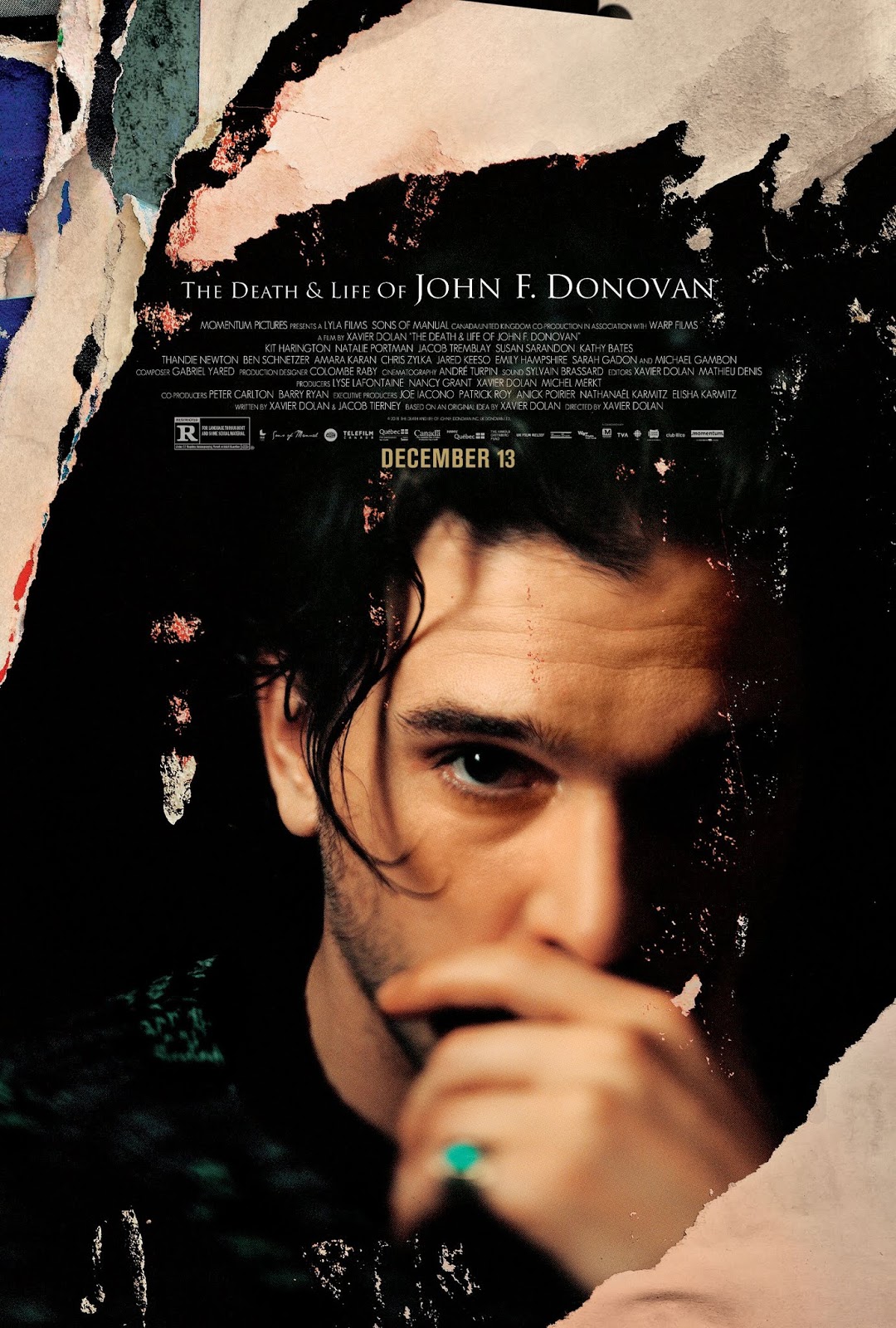
Watched an interesting film last evening called THE DEATH AND LIFE OF JOHN F. DONOVAN, a determined arthouse muddle that suffers for its ambition but is nonetheless a compelling watch that I'd recommend.

The film boasts an impressive cast: Kit Harrington (fresh off GAME OF THRONES), Susan Sarandon, Kathy Bates, Natalie Portman, Thandie Newton, Michael Gambon, Jared Keeso, Chris Zylka, Amara Karan, Ben Schnetzer, and an astonishingly good Jacob Tremblay (of ROOM fame). Jessica Chastain was also in the cast, but her part was excised from the final cut of the film in an effort by director Xavier Dolan to address issues with pacing and the film's running time.

In 2006, the title character (Harington) is a popular TV and movie star and the object of an 11-year-old aspiring thespian named Rupert's (Tremblay) devout fan worship. Rupert, an American expat living in England with his drifting, neurotic mother (Portman), is a precocious outsider struggling to fit in and subject to the cruel bullying by classmates that carries a strong undercurrent of homophobia. One source of comfort in his isolation is an unlikely (and clandestine) pen-pal correspondence he strikes up with Donovan and the string of handwritten letters they exchange over the five years before Donovan’s shocking tabloid-ready death.

The film totters back and forth between 2006 and 2017, as adult Rupert (Schnetzer)—also now an actor—publishes a book around the now-infamous correspondence and Rupert's interpretation of Donovan's tragically short life in the context of his writings. Using an interview with a reluctant journalist (Newton) in Prague, Dolan provides a serviceable—if somewhat anemic—framing device to recount the parallels and interconnected pasts of Donovan and the pre-adolescent Rupert.

Thematically, the film tackles quite a bit—the price of celebrity, familial resentment, the eternal struggle of self-acceptance at odds with the need for the acceptance of others, queer isolation, the impact that movies have in shaping our identities. It's a lot of philosophical meat to chew on, and this is where Dolan loses his storytelling grasp a bit. He seems determined to cram it all in and, unfortunately, some of the weightier themes get glossed over in his ambition. You’re left with the impression that Dolan’s film—despite its Chastain-erasing edit—would have benefitted from more time in the editing room. There’s also a nagging ambiguity about the epistolary relationship between Donovan and Rupert, with the impression of scandal hinted at but never delved into in any meaningful way. What was it about Rupert’s initial fan letter that caused an in-demand celebrity like Donovan to reply—and what was it in their subsequent letters that kept the correspondence going for years? These are questions that go frustratingly unanswered.

Visually, the film is a treat. Cinematographer André Turpin's sumptuous, burnished color palette and stylish camerawork lend a dreamy quality to the film. Likewise, the acting ensemble—particularly some of the supporting players here like Bates, Karan, and Gambon—grounds the film even when it threatens to go airborne with some of its loftier concepts. Sarandon, in particular, is excellent as Donovan’s alcoholic mother, even when her scenes splashing booze around threaten to descend into pure camp.

Despite its miscalculations, THE DEATH AND LIFE OF JOHN F. DONOVAN can be appreciated for Dolan’s confidence as a filmmaker. Although the cluttered fragmentation undermines the pace of the film at times, it also lends a surrealism that pulls you in. It’s a thought-provoking film that—despite how much it packs into its 123-minute running time—still feels unfinished. The film limps into the U.S. marketplace weakly in select theaters and VOD—arriving more than a year after its ill-received premiere at the 2018 Toronto International Film Festival—where I hope it finds some appreciation for the beautiful disaster it is.

Tuesday, October 15, 2019

Hilarity and Murder Afoot in ‘Knives Out’


There is a sweet spot where the classic whodunit (think: Deathtrap or Gosford Park or The Cat and the Canary or Agatha Christie’s The Mousetrap) meets comedy (think: Murder by Death or Clue or Private Eyes). And it’s writer-director Rian Johnson’s great affection for and shrewd understanding of that intersection between murder and laughter where audiences will find him in his cinematic wheelhouse, as evidenced by the brilliant Knives Out.

On the morning following his 85th birthday celebration, bestselling mystery writer Harlan Thrombey is found dead in his study—the victim of a seemingly self-inflicted throat slashing. But when renowned,  idiosyncratic private detective Benoit Blanc (Daniel Craig) shows up on the scene, it’s quickly established that he suspects foul play, with each member of the immediate—and pathologically dysfunctional—Thrombey family and household staff suspect in his murder. Flanked by local law enforcement—the straight-shooting Lieutenant Elliot (Lakeith Stanfield) and Trooper Wagner (Noah Segan)—Blanc questions each member of the Thrombey clan, during which  murderous motivations aplenty come to light as each spins a web of self-serving lies. Like a well-worn Agatha Christie paperback, clues are uncovered, red herrings misdirect, and the suspect list grows—then narrows—then grows again, with Johnson skillfully turning narrative tables before the big drawing room denouement.

The acting ensemble—a virtual who’s who of several generations of reputable Hollywood actors—includes Chris Evans, Jamie Lee Curtis, Toni Collette, Michael Shannon, Don Johnson, Ana de Armas, Katherine Langford, Riki Lindhome, Jaeden Martell, and the venerable Christopher Plummer, who—despite his early demise—has much to do in the film’s ample flashbacks. Even veteran character actors K Callan and M. Emmet Walsh show up for memorable bit parts, as does actor-director-puppet voice actor Frank Oz in the role of Harlan’s attorney. It’s enormous fun to watch these actors let loose onscreen with each other as evidenced to no greater effect than the “Eat Shit” scene that went viral from the film’s first trailer.

Each member of the cast is in top form—thanks in large part to Johnson’s astute ability to write good characters and snappy dialogue. Craig and de Armas are, arguably, the film’s leads and do much of the heavy lifting, their characters and performances serving as nice contrasts to each other. Craig is all wild-eyed energy and an oversized southern drawl—think a chicken-fried facsimile of Christie’s Hercule Poirot—while de Armas earnestly plays the more subdued moral center of the film as Marta, Harlan’s doe-eyed private nurse and surprising confidant. The rest of the cast, although largely relegated to the kind of supporting roles common to the ensemble whodunit, are each put to good use, with Johnson giving every single actor in his troupe some juicy material to work with—two, in particular.

Evans—in a nice change of pace from the do-gooder action hero roles that have largely defined his career in recent years—goes full-tilt rogue as Harlan’s trust-fund grandson, Ransom. He’s smarmy and snarky, swaggering and sneering throughout the film with gleeful abandon. Curtis also gets to flex her acting range nicely as Harlan’s eldest child, Linda, a driven real estate mogul who envisions herself as family matriarch in the wake of her father’s passing. She’s all business—crisp, and cutting right to the point—yet Curtis manages to use the character’s no-bullshit gravitas to great comedic effect, reminding audiences that she’s a deft comedienne who knows how to deliver a funny line. I’m also going to give a well-deserved shout-out here to Segan, who really proves himself to be a scene-stealer several times in the film, with genuinely funny outbursts that find his giddy superfan to the late mystery writer extraordinaire at odds with the dignified reserve required of his occupation.

From the opening scene—a wide shot of Thrombey’s stately (if not slightly sinister) mansion nestled in an autumnal-hued wooded countryside setting that’s accompanied by Nathan Johnson’s dramatic orchestral score—Johnson aims for a grandiose and archetypal cinematic composition. Setting is integral to Johnson’s visual storytelling, with the Thrombey family mansion dripping in an old-world New England neo-gothic aesthetic that’s almost a character onto itself. “The guy practically lives in a Clue board,” observes Stanfield’s Detective Elliot at one point in the film. Indeed, the house is cluttered with old-fashioned flamboyances like antique dolls and overstuffed furniture, ornate moldings and stained glass windows, and a writer’s study on the attic floor that will make any author—established or aspiring—drool. There’s even a spectacular chair made of knives that not only illustrates the film’s title but perhaps not-so-subtly suggests the deadly power grab at play à la Game of Thrones. Hats off to production designer David Crank, aided to immeasurable extent by David Schlesinger’s impeccable set décor, for a set design that really pops and saturates the film with much of its visual ambiance.

But the biggest star of Knives Out is Johnson’s masterful, slyly subversive script, which transcends the typical wink-wink, slapstick genre spoof. It’s fiendishly funny while remaining true to its classical drawing-room mystery roots, with a cunning labyrinth of a plot that never weighs it down or insults the audience’s ability to keep up. Johnson expertly toys with his audience’s narrative expectations—especially in the film’s second act when the reading of Harlan’s will drops a bombshell and the proverbial knives come out—allowing him an opportunity to layer in some razor-sharp commentary on upper-class entitlement and Trumpian politics. In one of the film’s funnier satiric threads, for example, the Thrombeys inability to remember Marta’s Latin American country of origin—despite their demonstrative declarations that she’s a member of the family—cuts to the bone of current national discourse on immigration. That Johnson’s able to take such shrewd political potshots without the heavy-handedness that might otherwise detract from the simple pleasures of the film’s popcorn entertainment pedigree is the true masterstroke of Knives Out.

The game is afoot, dear readers, and in Knives Out it’s best to surrender to being a pawn masterfully manipulated by Johnson’s ingenuity and adept juggling of his byzantine plot. By removing the stodgy seriousness of the standard whodunit without sacrificing its familiar conventions, he repositions and deconstructs the genre without descending into parody or losing sight of the source material that inspired this supersized romp. In the end, though, Johnson proves that people—like a poison-filled syringe—can be just as toxic.

Friday, March 8, 2019

Revisiting 'Amityville'


Among the sequel craze that started in the 1980s with Halloween and Friday the 13th, many might be surprised to learn that the modern-day horror film franchise with the most films to its name is The Amityville Horror. With a canon of 21 associated films (including sequels, reboots, and in-name-only knockoffs), The Amityville Horror franchise has eclipsed both Halloween (with 11) and Friday the 13th (with 12).
So it might come as a bit of a surprise when noted genre veteran Daniel Farrands—whose credits include screenplays for Halloween: The Curse of Michael Myers and the 2007 adaptation of Jack Ketchum’s The Girl Next Door, directorial work on a number of notable documentary features on film franchises like A Nightmare on Elm Street, Scream, and Friday the 13th, and numerous producer gigs—would mine the Amityville archives for his feature film directorial debut.
The Amityville Murders, which Farrands also wrote and produced, goes back to the real-life events that led to the original horror: The six gunshot murders at 112 Ocean Avenue, Amityville, carried out by Ronald DeFeo on the night of November 13th, 1974. DeFeo, in court testimony, claimed that voices coming from within the house drove him to kill every member of his immediate family. Although DeFeo was sentenced to (and remains in) prison, a mythos developed around the house itself when the Lutz family, who moved into the titular residence in late 1975, fled after less than a month because of the alleged supernatural events that served as the source material for Jay Anson’s bestselling 1977 book of the same name, which was based on about 45 hours of tape-recorded recollections from the Lutz family. The book became the ’79 film starring James Brolin, Margot Kidder, and Rod Steiger that went on to gross $86.4 million on a $4.7 million budget. In one of the longest-running acts of source material cannibalism, The Amityville Horror story has been artistically excavated, twisted and reconfigured, retold, and expanded upon for nearly four decades—with varying results.
Enter Farrands. Wisely, he opts to return to the scene of the crime—literally and creatively. Rather than add to the convoluted Amityville mythos, he chooses to revisit the story of Ronald DeFeo in what amounts to a proper prequel to the ’79 film. Diehard Amityville aficionados will note that 1982’s Amityville II: The Possession also attempted to loosely prequelize the pre-Lutz events, but Farrands’ outing is a more faithful retelling, coated with a nice period piece sheen.
The 1974 DeFeo’s are a suburban Long Island family whose outward picture-postcard success belies the dysfunction within. Patriarch Ronnie (an excellent Paul Ben-Victor) is the quintessential abusive husband and father, offering intimidation and beatings in private and paternal hugs in public. Wife and mother Louise (Diane Franklin) is that typical abused spouse who walks a fine line between trying to keep Ronnie’s rage at bay while facilitating some semblance of normalcy for her children. Eldest son Ronald (nicknamed “Butch”) is a directionless slacker and drug user while eldest daughter Dawn (Chelsea Ricketts) is smart, pretty, and protective of her older brother. There are three other siblings—Alison, Marc, and Jody—but they’re largely relegated to the periphery here, with Farrands choosing to focus his narrative on the DeFeo parents and their two oldest offspring.
Farrands spends time painting his cinematic picture of the DeFeo’s and their dysfunction—from Ronnie’s shady mafia dealings to Ronald Jr’s drug use and the especially volatile relationship between the two. At some point early on, both Lainie Kazan and Burt Young (who, in a nice wink to franchise fans, was also in Amityville 2 with Franklin) show up as Louise’s parents—with grandpa Brigante gifting Ronald and Dawn new cars on their shared birthday and Nona getting her hackles up when Louise casually mentions a possible West Coast relocation. “You’re going to sell my house?” she asks, practically drooling ill-omen. These early scenes are outstanding, even if the Long Island accents are a tad too exaggerated and the family’s Italian-Americanness bordering on caricature at times.
It’s revealed that Ronald Jr. and Dawn also mess around with the occult down in a little basement crawlspace with red cinderblock walls (aka the infamous “Red Room”). At some point, the dark forces within the house (it’s purported to be built upon land where the local Shinnecock Indian tribe had once abandoned their mentally ill and dying, an idea rejected by local Native American leaders) start their whispering through the walls and take possession of Ronald Jr. that culminates in the murders. The supernatural foreplay is effective although most of the visuals and set pieces will ring familiar to anyone who’s seen a Paranormal Activity film. Recycled but competent scares abound as the tension escalates.
Overall, The Amityville Murders hits its marks. Caveat: I’ve not seen a single Amityville film since the three-dimensional third so I may not be as jaded or franchise-weary as many reviewers seem to be. Farrands’s direction is solid, his pacing tight, and he really knows how to strikingly frame his shots. He also gets some major props for giving Diane Franklin a role befitting her talent. She’s been too-long relegated to shorts and subpar material in recent years for an actress of her stature and talent.
The standout here is John Robinson who does most of the film’s heavy lifting as Ronald Jr. He convincingly portrays a man slipping into madness, seamlessly shifting from anger and rage to vulnerability and melancholy with all the requisite raw emotion. It’s actually in considering Robinson’s performance where one might realize that Farrands missed a golden opportunity to muddy the waters a bit and aim higher with his franchise contribution. Instead of presenting the audience with a predetermined supernatural origin to Ronald Jr’s slip down the rabbit hole, layer in some ambiguity to suggest it might have been the drugs or PTSD from years of mental and physical abuse or even an undiagnosed mental illness like schizophrenia (the onset of which would correspond with the character’s age)—perhaps a combination of all these internal and external factors. When you make a movie based on real-life events and your audience knows the story’s ending from the outset, you need something else to make your mark. Leaving the audience pondering—and ultimately deciding for themselves—the origin of Ronald DeFeo’s eventual murderous snap would have added a decidedly cerebral element that would have elevated The Amityville Murders beyond the limits of its well-trodden zip code. 

Friday, February 1, 2019

‘Suspiria’: An Exercise in Arthouse Existentialism


Director Luca Guadagnino’s interpretation of Suspiria, Dario Argento’s 1977 cult-classic, supernatural horror film, is ambitious, overstuffed, and dazzlingly convoluted—in other words, it’s brilliant. The film—as an overarching metaphor for insurrection and the transference of power—works on almost every level and establishes itself as less a remake and more a companion piece to Argento’s classic.
Guadagnino’s take is set against the riotous backdrop of a wall-divided, post-war Germany circa 1977, terror-ravaged by Red Army Faction bombings and background news reports chronicling the hijacking of a commercial airliner. Into this sociopolitical bedlam—which is largely superfluous to the film’s narrative—enters Susie (Dakota Johnson), a talented but inexperienced dancer (and former Mennonite) from Ohio who shows up at a legendary all-female dance company in Berlin for a long-shot audition. As luck would have it, a roster spot has opened up after another dancer goes MIA, and her subsequent impromptu audition draws both the attention and tacit approval of the company’s enigmatic artistic director Madame Blanc (the unrivaled Tilda Swinton in yet another memorable role…or three). The preternaturally gifted Susie quickly ascends the ranks as Blanc's protégé, earning her the role of the protagonist in the company’s upcoming recital of Volk, which we quickly surmise has all manner of consequential otherworldly implications.
While most of the hallmarks of Dario Argento’s original giallo are present and accounted for, Guadagnino and screenwriter David Kajganich add a new character named Dr. Josef Klemperer, who is introduced in the updated film’s first few minutes. One of the elderly psychotherapist’s patients is a student from the dance academy named Patricia (whose mania is played well by Chloe Grace Moretz) who rants about a coven of witches that controls Markos Dance Academy and the evil of “the Three Mothers”—a witch mythology Argento refashioned from the writings of Thomas de Quincey—in a nice meta-tribute to Argento’s original trilogy. Klemperer—haunted by the wife he lost in World War II and stricken with an all-consuming survivor's guilt—is particularly invested in helping Patricia. The character is played by a first-time actor credited as Lutz Ebersdorf—but it’s largely known now that the role is played by Swinton in drag. There could be much said here about Guadagnino’s choice with this bit of stunt casting in terms of feminist themes and gender fluidity, but the casting largely misfires because he’s generously peppered the entire film with so much thematically elsewhere. One legacy of the reimagined Suspiria that’s a given: The film will give film scholars and other academics years of material to dissect.
On the surface, Suspiria is an odd choice for the Italian director after the blockbuster success of his plaintive coming-of-age romance of last year’s sublime Call Me by Your Name. Trading in the sun-dappled Italian vistas of his previous film for the darker muted tones of the grittier, concrete jungle of post-war Berlin here, Guadagnino—aided by the superb camerawork of cinematographer Sayombhu Mukdeeprom—creates a purposeful contradiction to the Technicolor palette and deep jewel tones of Argento’s original. He opts for a severe and dispiriting look, its colorlessness periodically punctuated by vivid slashes of blood red to excellent dramatic effect. Mukdeeprom’s abrupt, purposefully clumsy whip-zooms charging toward the actors and the unexpected acceleration of cuts during otherwise unhurried scenes lends the film an authentic 1970s aesthetic that unites the two set design approaches.
Argento’s original Suspiria vision established tone largely through set design; Guadagnino opts to use dramatic choreography (mad props to choreographer Damien Jalet) to establish mood and escalate tension. Early on in the film, there’s a gut-churningly intense set-piece in which Susie’s feverish Salome-esque dance for Madame Blanc is juxtaposed against another dancer—whose attempt to flee the academy is thwarted by witchery—whose body is tossed around an adjacent dance studio and contorted in the most unearthly ways until she’s nothing but a protuberance of broken, misplaced bones. Aided by Walter Fasano’s precision-point editing, the scene is a strikingly gross yet captivatingly poetic bit of body horror.
Likewise, Guadagnino opts to choose his own fork in the road instead of following Argento down the same path he took with the original film’s score. That score—by Italian prog-rock band Goblin—was an intense wall of sound that blended screaming guitars, synthesizers, and wordless vocals to create an almost-deafening sound that matched the off-kilter, horror-schlock ambiance and garish visuals of Argento’s film. For his Suspiria, Guadagnino counters by engaging Radiohead’s Thom Yorke, who ably captures the idea of descending into madness with his intricately languorous and brooding updated score.
Suspiria ’18 is a bold revisionist interpretation of Argento’s unassailable masterpiece, a refreshingly challenging film infused with an almost existentialist sense of dread. It’s a hypnotic exploration of the catharsis of female rage in which witches cast their spells through dance and, in the end, the ugliness of destruction is offset by the beauty of unexpected absolution. It’s a film that demands repeat viewings, if only to unpack its layers of themes. Loyalists are certain to appreciate Guadagnino’s inclusion of a touching cameo by Jessica Harper (the original film’s heroine) but fans expecting jump scares and a clean, linear narrative should look elsewhere; Guadagnino’s modern re-telling is a dense and cerebral slice of arthouse that’s as satisfyingly trippy as the original in its own right.

Monday, January 21, 2019

Curtis Anchors 'An Acceptable Loss'

It’s hard to compete with the real-life drama coming out of Washington D.C. these days, but Joe Chappelle’s An Acceptable Loss attempts to do just that with this thought-provoking political thriller in which decisions made with the noblest of intentions still help pave the road to hell.   
Former top U.S. security adviser Elizabeth "Libby" Lamm (Tika Sumpter) is a woman haunted by just such a decision—one made during her tenure working for and at the bequest of then-Vice President Rachel Burke (Jamie Lee Curtis). As draftswoman of a plan that led to America dropping a nuclear bomb on a Syrian city that resulted in mass causalities numbering in the tens of thousands, Libby knows that parts of an influential report that led to the aerial strike against a suspected terrorist stronghold were falsified. And, although she initially fulfills her role as a dutiful soldier by helping Burke convince the American public of the legality of the administration’s actions, her conscience is getting the best of her as the full ramifications of her decision play out in the ensuing five-year period. Reduced to a moral and political pariah, Libby takes a teaching position at a Chicago university where her very presence is protested by students and some faculty alike despite the support she receives from the kindly Dr. Willa Sipe (THE VISIT’s Deanna Dunagan). In a scene-stealing cameo, SEX AND THE CITY’s David Eigenberg—here as an unnamed drunken colleague—confronts Libby at a faculty mixer, demanding to know how many innocents she helped murder. It’s no surprise then when a guilt-ridden Libby starts scribbling down a full account of what went down leading up to execution of the Burke Doctrine on yellow legal pads in anticipation of owning up and coming clean. The convenient fact that her father (the always-solid character actor Clarke Peters) is a prominent newspaper editor seems like the logical means to do so. 


But—like all good political thrillers—there are complications. Libby’s take the form of a sullen graduate student named Martin (Ben Tavassoli) who’s stalking her for reasons that are as apparent as his obvious national origin and her old boss, who’s now gearing up for a run to become a second term President. Thrown into the mix is Adrian (Jeff Hephner), Burke's ruthless chief of staff and Libby’s former lover, who makes it clear during his own surveillance activities that Libby is either with them or against them. Cue ominous music. 

Marketing tags are everything, and An Acceptable Loss—as political thriller—will come up short for some since two-thirds of the film is decidedly more political drama, a key distinction. In fact—although Chappelle (who also penned the script) ably ups the thriller quotient in the film’s third act with twists and turns that deliver a strong one-two punch—it’s what precedes the action-packed finale that provides both the film’s strongest asset and biggest missed opportunity: The relationship between Libby and Burke. Indeed, the best moments in the film come via flashbacks between Sumpter and Curtis’s characters—an escalation of the power dynamic between a woman in power who’s seeking more and a woman just beginning to ascend the ranks who sees the real possibilities ahead of her. At first, Burke makes a passionate, hardline case for what she wants to do to the reluctant Libby, attempting to justify the collateral damage by appealing to the younger woman’s sense of “for the greater good” and patriotism; later, we see Burke’s steely resolve as she manipulates Libby using guilt and fear to bring her around. These are magnificent scenes—especially for Curtis—in which the power dynamic between educated women in positions of authority and influence is explored.  Unfortunately for An Acceptable Loss, these scenes and that driving dynamic are relegated to these expository sidebars when they had, in fact, the potential to drive the entire film into interesting and far more dramatic territory.
Sumpter, although appealing as an actor, seems miscast here. At first I thought it was an age thing—that she might have been too young to be playing a seasoned political advisor—but the actress is actually approaching forty, just the right age for the character and her level of accomplishment. Tavassoli, as Martin, is engrossing despite not being given much to do through two-thirds of the film but skulk around Libby’s empty house and act creepy. When he is given something meaningful to do, he ably rises to the occasion. Curtis is the crown jewel of the ensemble and the best part of An Acceptable Loss, taking what could have been a one-note villain role and layering her character’s outward fierce determination and ambition with a tragic sense of misguided nobility and, later in the film, even a note of remorse. It’s interesting that while Christian Bale is garnering accolades for his portrayal of Dick Cheney in another film, Curtis may embody the former VP’s hawkish calculations and puppet-master political persona even better here.
Curtis has entered an interesting phase of her career where her maturity grounds her performances in a captivating gravitas, elevating her dramatic chops into the provinces of the Frances McDormands and Glenn Closes of the acting world. Her chilling portrayal of a politico hell-bent on seeing her vision through at all costs—her reasoning for changing U.S. policy regarding first-strike attacks alone should resonate against the backdrop of today’s geopolitics—is easily one of the best performances of her career. Yes, we know she’s a veteran scream queen and an accomplished comedienne; but let’s hope that the roles coming her way in her own third act take full advantage of this newly-engaged aptitude for drama.   


Watching An Acceptable Loss, one can easily lament Chappelle’s misdirection in opting for straight-forward political intrigue over a nuanced character study of two powerful women—one in a position of authority, the other in a position of influence—and how the subtleties of this power dynamic impact and affect the world around them, but Curtis’s first-rate performance should make that bitter pill easier to swallow. Come for Curtis, stay for Curtis, and be surprised by the third-act tricks Chappelle’s got up his sleeve.